
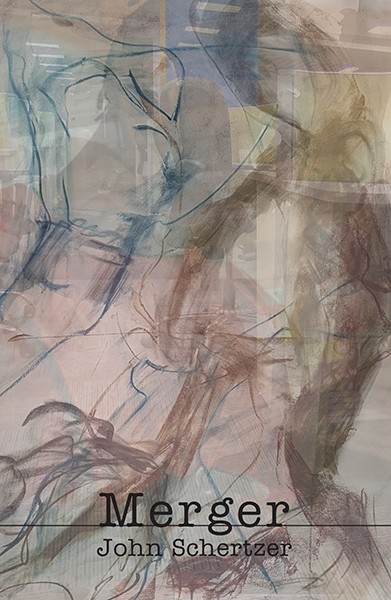
John Schertzer’s Merger opens in the New York offices of OsciliMandayUS. In the opening paragraph, one of the lead characters describes the weather coming in as he gazes through the office windows. Snyder states, “There were numbers in his head, the way they often are, churning his brain habitually. It was the balancing, that constant rain of calculations, that wouldn’t let him take in the full experience of the sky, and that was possibly a good thing, at least for the moment.” Much of Schertzer’s sprawling novel is an act of balancing, watching characters slowly unravel the dreary technological offices they inhabit and impending collapse, endlessly balancing numbers and calculations in their minds, as storm clouds quickly approach on the horizon. The mighty works of technology merging with our minds will leave little in its wake but fragments of ourselves. The wonderful play on Shelley’s “Ozymandias” is evident throughout the novel. Particularly noteworthy is the ironic play on these lines: ‘My name is Ozymandias, king of kings:/ Look on my works, ye Mighty, and despair!’/ Nothing beside remains. Round the decay/ Of that colossal wreck, boundless and bare/ The lone and level sands stretch far away.” Schertzer’s book is a dark philosophical novel around the modern tech office, and it champions the relentless pursuit for an authentic self amid endless distractions and constant surveillance, even if that means reassembling fragments from the far sands of time.
Merger centers around four characters, grappling with their disappointment and disillusionment in a corporate tech office, pending a merger. What brings them together is the realization that Semblance, a program that can summarize large groups of people, create ways to manipulate them, and design matching patterns to create a hypnotic world of endless feedback loops is one of their projects. What makes Schertzer’s novel so poignant and fascinating is the characterizations. Much is revealed in the fractured interior monologues of the four central characters. There’s Snyder, a young twenty-something tech who really doesn’t fully get what’s he doing in the office, except he’s got a crush on Amber. Amber, a young multiracial bisexual woman, wonders why she left her PhD program in pragmatism or hasn’t pursued other studies. Khalil, an African American poet, does spoken word in the bathroom and considers racial identity. And Redroth, the middle-aged news junkie, somewhat burned-out, often wonders how he wound up here, wrecked and lost. Redroth is married to the poet, Pam, and hangs on to his work for a salary to provide for his family, even though he’s often a target for the tyrannical manager Flo. For me, Redroth is the anchor the group, for he wonders what life would be like elsewhere. He ponders philosophy, Marxism, and technology merging and manipulating his mind and identity throughout the novel. In fact, at one point he muses about the fate of Lily J, a woman from his past, who got rid of the whole corporate enterprise to live a more authentic existence serving others in need. “And Lily J decided early on to chuck the whole thing—if she was going to be consumed by activity it was going to be against the forces that typically inhibited one and to actually do something worthwhile for others, basically to fuck off the entirety of the congested system of defaults that have emerged as habit and live a life according to a set simpler but energized originating values. In other words, she had shaken off the gray muck of civilization to live a human life.” This is the strength of the book, watching these characters and their questions about themselves and the system emerge in the dim light of the office, as individuals who are seeking something more out of life and out of themselves.
What each character ultimately grapples with is their relationship to Semblance, whether they accept it as positive for their lives or reject it completely as the monster Matrix. Schertzer creates these four figures through their questions and decisions. And each finds different paths to new love, new acceptances, or reaffirmations of past identities that have been frayed. It’s an intellectual feast, especially as you make your way to understand what looms. Pam has a wonderful epiphany for Redroth about Semblance late in the novel: “It’s what they put out there for you to invent for yourselves so that your minds would get so crowded over this thing that you literally cannot think for yourselves.” This seems an apt way to capture the saturation of media and newsfeed manipulation of our times, and Schertzer manages to grapple with deep existential, material, and technological forces without losing sight of the humanity and duality of his major characters. In essence, the merger occurs as each character finds new understandings of themselves and reassembles the fragments that have been worn down by technology and time.
Some of my favorite moments in the novel, occur as characters cite intellectuals in their quests for reformation. Amber reasons she should have studied foreign languages. Khalil cites Amilcar Cabral. Redroth cites Jean Genet, grabbing whatever appealed to him to create. Redroth called it “a whirling mob of detritus picked up here and there.” Or Pam reminding her husband of Keatsian Negative Capability: “Neg Cap: to bear that experience in comfort, and still be able to act as though one knew what one was doing, to live one’s life, make choices without complete knowledge…” This is the strength of the book, watching characters face a dreary techno-capitalist landscape and finding idiosyncratic intellectual means to reassert personal freedom and identity. Yes, a Semblance technology may have altered these characters, like big data and social media tend to do, but it doesn’t mean they’ve given up in sorting through the fragments to continue their individual quests for meaning and purpose. The merger here is really one about the characters, as they reassemble themselves after corporate disillusionment and dissolution.
Merger
by John Schertzer
Spuyten Duyvil Publishing; 324 p.