
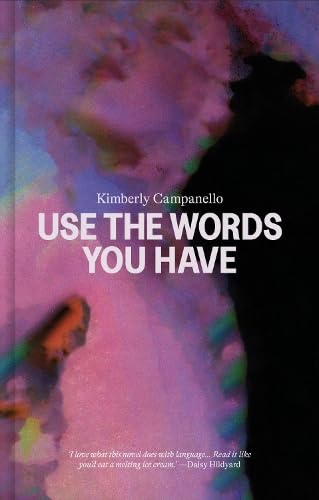
What is the literary equivalent of chocolate and peanut butter? It’s probably not formal inventiveness and eminent readability. Alternately, here’s a sentence that most readers will never utter: “That novel took all kinds of big structural swings; it’s the perfect beach read!” And yet, what if those two qualities could be seamlessly assembled? Enter Kimberly Campanello’s Use the Words You Have.
The premise of Campanello’s novel is relatively straightforward: a young woman, referred to as “K” in the narrative, travels from the United States to France for the summer, where she falls for a man (“M”) living in Breton. So far, it’s familiar stuff: a protagonist far from home embarking on a serious relationship for the first time. It’s a classic setup for a reason, but where Campanello excels is in the different ways Campanello gets into K’s head.
Initially, Campanello eases the reader into the narrative with third-person descriptions of K’s experiences upon arriving in France, and memories of her conversations with her mother about what to pack. And then, a few pages in, something shifts, and we’re given a chapter one sentence long: “I trace the air and the wind returns.”
Presumably, this “I” is “K,” but the context is temporarily withheld. It’s a destabilizing moment, but that fits: K is away from home, and the academic program that’s brought her to France requires her to speak the language for the duration of her trip. Other references to K’s family life suggest other ways in which she is experiencing new things: there’s a sense that her family is more protective of her than some of her peers’ parents are, which leads to her not receiving formal permission to drink alcohol. (It’s a legal grey area due to the difference in legal drinking laws between the two countries.)
Use the Words You Have is a novel that establishes its own structure, then gradually picks it apart. At first, it seems to be the story of one summer in its protagonist’s life; it’s more than that. At first, it seems to be told in the third person; it’s not. At first, it seems to be structured around an immediacy; gradually, a sense of years going by enters the picture.
Campanello handles this elegantly, allowing the reader to see K at various points in her life. But she also allows room for other characters to shift as well: there’s a stray reference to a priest, Father Michael, who K searches for online years after her trip to France. He is, she learns, no longer a priest, and has moved away from the state where he once lived to a new city.
“He writes about that city’s socialist history and gives political tours,” K tells us. “Michael interprets the relics of the past. I buy his book.” He may have left his religious vocation behind, but this is a moment of grace nonetheless. This novel is full of them.
***
Use the Words You Have
By Kimberly Campanello
Somesuch; 204 p.