
Writing With Friends, Writing About Friends
by Kaaron Warren
It was only once I finished the first draft of Going to Summertime that I realised something important that lay at the heart of it. Friendship. The importance of it, how it can save us, but also how it can destroy us, and how it can’t always be relied upon.
I wrote the bulk of this novella on a road trip with a group of friends. We’d all sit on the balcony and write, and I can tell you it was hard to keep horror focussed, on a sweet, warm day, with good friends close, and snacks, and a comfortable chair. But that’s part of the wonder and challenge of writing; taking yourself elsewhere. Writing about a dark rainy night, when you can smell the blossoms, hear the birds, feel the warmth of your sun on your skin. Adding in a scene that makes your skin crawl, while a friend naps, head nodding, tiny snores so endearing.
I love these writing challenges.
Our writing/road trip was full of fun, food, and laughter. That sense imbues Going to Summertime. Amongst the ghosts, and awful crimes, the wrecks of houses, the strange last residents, there is this sense of friendship.
It made me reflect on a life’s worth of friendships. Some I still have after 40 years. Others are long forgotten. I found a birthday card the other day, in a book. I guess I used it as a bookmark. It said, “To my dearest friend Kaaron, I treasure our friendship. Party on!” signed…someone I have absolutely no recollection of, no matter how much I wrack my brains. And yet the friendship must have been intense at the time. And we did party on, I’m sure.
Friends fill so much of our time, especially at school and work. We bond and make connections we might not have made otherwise, and these connections help us get through the day. Without school and work friends, each day would have been duller.
From Blyton’s school stories, to Donna Tartt’s The Secret History, and Stephen King’s Stand By Me, and so many more, friendship groups carry the story. I envied the world of The Secret History. I envied that life, those cool friends. The banter, the parties. I didn’t want what they had, but I wanted some of it. The same with Enid Blyton, and the Malory Towers stories, the Naughtiest Girl in the School, all of them. I wanted to be at those schools where friends were family, and everything was fair, and you got toffees in your tuck box.
Friendships are easier to manage in fiction than families are. There’s a freedom in the construct that family doesn’t always have. There are fewer natural obligations. There are also fewer shortcuts, though. You have to work harder to build those fictional relationships. Show connections, shared humour, shared trauma. A family can just ‘be’, but friendships need to be made. This is true in life as well as in fiction.
There are sometimes friendships as transient as the tide. To this day I make this kind of friend. As a child and young teen, I always found a holiday friend when my family went away. Someone to meet up with, hang out with. Recently at a small bar in Barcelona, I struck up a friendship with a woman that lasted all of 45 minutes, but in that time it felt like years. It felt like we’d shared birthdays, gossip, heartbreak. And while we made no permanent connection, she has a tiny place in my heart.
There are friends who were dear to me, but who shifted into a wilder world than I wanted to move in, with drugs, and no work or school, no future but now.
And watching them sink into it, leaving me in the reality of the filthy room, the empty cupboards. We would go out to find hot chips later and I would keep on walking.
Old friends are like a part of myself. We’re direct and honest but never cruel.
There are untrue friends, who turn on you, desert you, leave you crying in bathroom in a bar far from home.
I bring all of this to Going to Summertime. Georgia, who owns the Red Mullet Salon, tries to remain professional. She thinks friendships in the workplace can lead to concessions, favours asked, corners cut. But once they’ve all been to Summerland Place, her perspective shifts and she understands what is really important.
Erin loses sight of this, taken in by Milton, their charming host. Many friendships falter when a lover enters; those that survive and grow are the stronger for it.
Sunnie has always had the wrong kind of friends, but there’s a seduction on that. Called into that world, enjoying it, taking each moment, living only in the present with no thought of consequence.
I’m not like that. She’s not me. None of the women are me, although perhaps they do each represent an element of my friendships.
Going to Summertime is not about friendship. It’s about a haunted cul de sac, and the malevolent history of each house, and the vicious presence of the living.
But it wouldn’t work as a story if these four women weren’t friends.
Shirley Jackson award-winner Kaaron Warren published her first short story in 1993 and has had fiction in print every year since. She has published six multi-award winning novels: Slights, Walking the Tree, Mistification, The Grief Hole, Tide of Stone and The Underhistory, and seven short story collections, her most recent being Calvaria Fell, with Cat Sparks, from Meerkat Press. Her stories have been shortlisted for the World Fantasy Award and the Stoker, and appeared in both Ellen Datlow’s and Paula Guran’sYear’s Best anthologies. Her writing podcast Let the Cat In showcases ideas, objects, and inspirations.
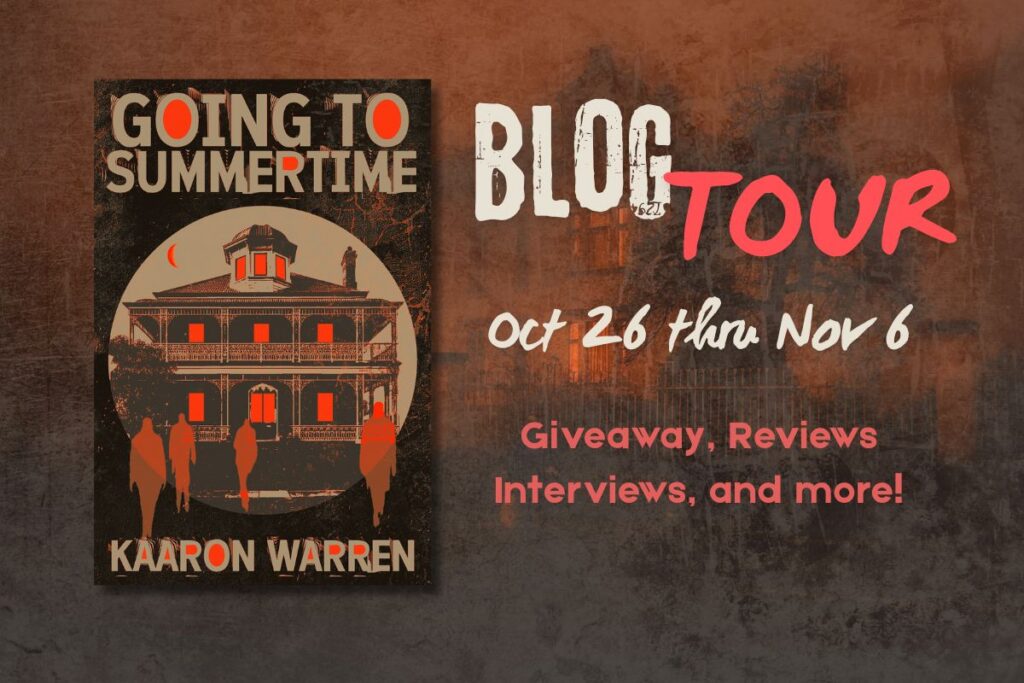
This essay is part of Kaaron Warren’s blog tour for the novella Going to Summertime. Visit Meerkat Press’s website to visit more stops on Warren’s (virtual) tour; Meerkat is also holding a giveaway for a gift card as part of the tour.