
From Costume Designer to Illustrator and Author: An Artist’s Journey
by Bill Crisafi
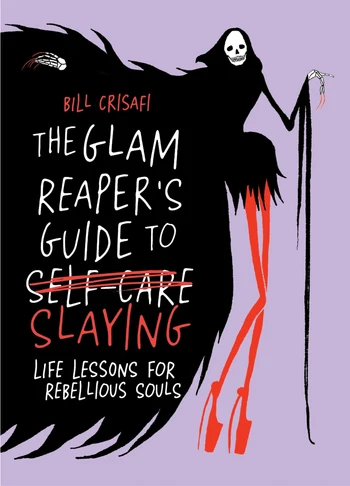
My path from artist to author is something that wasn’t in my consciousness at all, but it ended up appearing at a time when I needed it most. I went from starting in fashion school and ultimately finding that general fine arts was a better fit, navigating the early days of Instagram to amassing over 300,000 followers and creating a brand using my illustrations as a guiding force. That path eventually led me to write my first book, The Glam Reaper’s Guide to Slaying, which is essentially an adult children’s book meant to bitch slap you into remembering you’re a fabulous diva.
I started college at the Fashion Institute of Technology in 2008. I was certain I would be a famous fashion designer.
Well, that didn’t happen.
I still love clothing and design, but I quickly realized FIT was very corporate. As I learned how to drape, sew on a machine, and properly use a goddamn ruler (don’t make fun of me—it was embarrassing enough at the time), I became discouraged by professors telling us they were preparing students for “the real world.” The real world apparently involved sitting under fluorescent lights in a Target office somewhere making t-shirt tech packs.
No fucking thank you.
My dream was the fantasy I saw on the runways. Haute Couture, mama.
Thankfully, my ass was accepted into the coveted Illustration Specialization program my second year there. While I would still have to do tech packs and boring work, I would not be in the Project Runway-style workroom until 5 a.m. making my term garment. I’d be in a quieter room, with fewer people, drawing until 5 a.m.
SIGN. ME. UP.
All jokes aside, this program helped me tremendously as an artist. It’s where I refined the character who still appears throughout my work today. She started as a gap-toothed morose model who danced between being a ghost, a witch, and anything fantastical in between.
The best part about illustration at FIT was that I didn’t have to operate within the constraints of making a garment. Your imagination was your greatest tool and technical construction wasn’t the focus. I got to come up with stories about the models, where they were from, and how their environments informed the textures and colors they wore. One of my favorite projects involved gathering dried milkweed and plant specimens around my hometown because my girls were going to be haunting a home in New England in the middle of a marsh.
I realized that what excited me most wasn’t just designing the clothing—it was imagining who was wearing it. I found myself spending just as much time thinking about the characters themselves as I did rendering the perfect dolman sleeve. Looking back now, that should have been my first clue that storytelling was becoming just as important to me as image making.
After leaving FIT, I found myself in the polar opposite BFA program at the School of the Museum of Fine Arts in Boston.
The minute I got there I realized maybe I did need a little bit of structure.
This place was loose. For me, too loose. When I say loose, I mean I walked into my first animation class and my professor was napping on a sofa. Actually asleep. I was pissed.
The upside was that I could take any class I wanted and have it count toward my degree. Welding, plaster work, video, and gestural drawing were a few areas I found myself exploring. Drawing alone was no longer my main focus and I was able to experiment with other mediums while weaving together stories between all of these new projects.
SMFA, as crazy as it was at times, definitely helped me with world building. I wasn’t just making girls on paper anymore. I was creating stop-motion animations with forest witches, welding together childhood memories, and making videos that were unsettling and funny.
In hindsight, I was building my brand long before I realized it.
This is around the time Instagram launched.
I started using it immediately and began sharing things I found inspiring around New England. Unlike Facebook, which was riddled with digital camera photos of underage drinking and college outings, Instagram felt like an artist journal. It felt safe and freeing.
Whether I was visiting my favorite flea market and photographing an interesting row of chairs, exploring abandoned buildings overtaken by ivy, or posting sketches inspired by these subjects, Instagram became a collection of visual influences that informed my work.
I didn’t really lean into posting illustrations until I started working at a nightclub in Boston. Please don’t tell my old boss, but I was drawing during my shifts and posting them to pass the time. Late nights were a bitch and the door was SO SLOW after a show started, so it became fun to see who was discovering my work. This was long before the algorithm had us all in a chokehold. The app felt exciting and fresh. For the first time, I felt like I could connect directly with strangers who understood what I was trying to create. I could see a life beyond the nightclub door.
I was still in art school and started thinking about products I could make after meeting a very kitschy screen-printing professor one afternoon. That conversation eventually turned into me making prints in the school’s computer lab and dreaming about other ways I could use my artwork and understanding of design to build something bigger.
As Instagram evolved, so did the way people consumed art. Detailed drawings and works in progress no longer seemed to resonate the same way. Videos were taking over and attention spans were changing. All of my characters lived in the same world and you could learn a lot about them through the illustrations themselves, but I started wondering what would happen if I gave them a voice.
And then I drew a toad named Babushka.
Her knee-high stockings were uneven, she wore a plaid miniskirt and headscarf, and she had a very strong opinion about the “bitch turtle” who lived next door. I started writing blurbs about her, her pet snail Slimy Catherine, and their various adventures. What surprised me was that people weren’t just responding to the drawing. They were responding to her personality.
Up until then my work had been more melancholic and whimsical. Humor wasn’t really at the forefront until Babushka. That character completely changed the way I approached storytelling.
That developed into the work I make today, where I pair illustrations with jokes or phrases that make even the strangest characters feel relatable. Not many people see themselves as a naked figure with a crescent moon for a head and crow talons for feet, but when the caption says, “My ass is fat and my heart is pure,” suddenly there’s something human there.
I guess I started writing long before I considered myself a writer.
After finding success in this new rhythm, I started experiencing burnout and depression. The pandemic played a role, but so did the pressure of trying to create “viral” art for a living. I felt like I was constantly chasing something I couldn’t fully control. At the same time, my mother was diagnosed with an aggressive form of lung cancer. We were incredibly close, and the diagnosis that eventually led to her death last year shifted my perspective entirely.
During that time, I got the opportunity to write and illustrate The Glam Reaper’s Guide to Slaying.
I’m not being dramatic when I say the project, the deadlines, and the subject matter helped pull me out of a dark place. Looking back, it’s almost funny that a character whose entire purpose is giving life advice ended up helping me through one of the hardest periods of my own life.
I am especially grateful because I was able to inject my mother’s no-nonsense New England charm into the Glam Reaper herself.
It was the last major project of mine that she knew about. She knew the Glam Reaper’s personality was inspired by her, and I couldn’t be happier about that.
I only wish she got to read it.
At the time I wasn’t sure I could write a book. Looking back now, I realize I had been preparing for it all along. The world building from illustration, the storytelling hidden inside captions, the characters I carried with me for years, and even the difficult experiences that shaped me all found their way into those pages.
I was able to take a lot of negativity and turn it into something rooted in humor, love, and resilience.
I know this will be one of many books to come.
Bill Crisafi is an artist and costume designer. Originally from Salem, Massachusetts, his work is influenced by the occult, drag, and fashion. His illustrations explore themes of magic and folklore, merged with camp and humor. Crisafi holds a Fashion Design degree from The Fashion Institute of Technology, as well as a Fine Arts degree from the School for the Museum of Fine Arts & Tufts University. The Glam Reaper’s Guide to Slaying is his first book.