

This fall brings with it a new edition of Lafcadio Hearn’s Japanese Ghost Stories, published by the Folio Society. This edition includes an introduction by Yoko Ogawa and new illustrations by Yuko Shimizu. I spoke with Shimizu about her work on this edition, her experiences with Hearn’s fiction, and more.
Was working on this edition of Lafcadio Hearn’s stories your first encounter with them?
I am originally from Japan, so I have known these stories for a long time. Though it was probably the first time I read his books extensively. (This book is a compilation of some of the most iconic stories he has written over time, mainly from Kwaidan, his most famous book, but some other books as well.)
As a reader, do you have any personal favorites?
The Hoichi story is the most famous one of all. I remember I used to be so scared of it as a child. It was my favorite one to illustrate for this book.

Were there any aspects of Hearn’s prose that you found especially inspiring?
I don’t know if it is the answer to your question exactly, but I always think it is fascinating he is the ghost stories writer in Japan. He has a Japanese name under which his books were published in Japan and still cherished among Japanese readers. We all know he was an American, but we still think he is the writer.
It never occurred to me he wrote these in English. I think many of us believed all were written in Japanese.
You also have illustrations coming up for a Haruki Murakami book; how does collaborating with a living author on a project differ from something like this?
Every book project is different, and finding the right theme, or direction, for each book is the most important. For Ghost Stories, I decided to make them look like fake Edo period book illustrations which was fun.
I don’t have direct contact with Murakami, but I hear he usually lets the artists do their job and says “looks great, thank you” unless there is something really wrong. I appreciate the trust he has in artists. I have been a huge fan since forever.
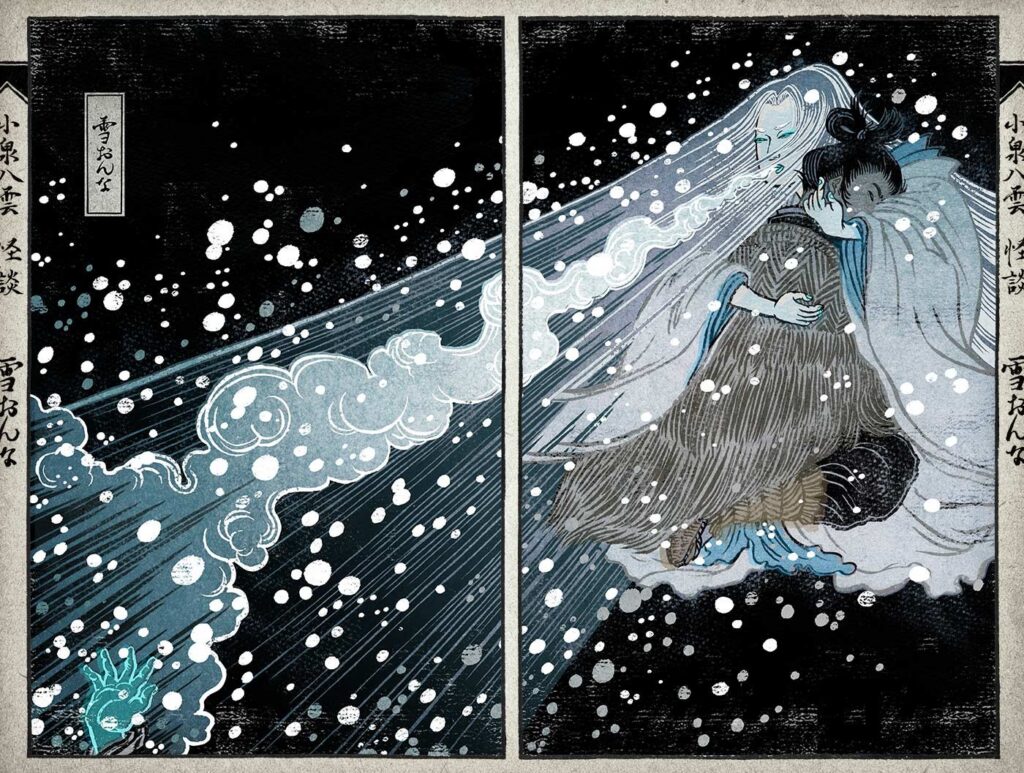
When illustrating supernatural beings, did you find yourself looking to traditional depictions or pushing into new territory?
Both. I did make the illustration into fake Edo book illustrations, but at the same time, I have to reflect the fact I am an artist living and making art in the 21st century. I have intentionally included some elements, like colors Edo period books had never used, for an updated fresh look.