
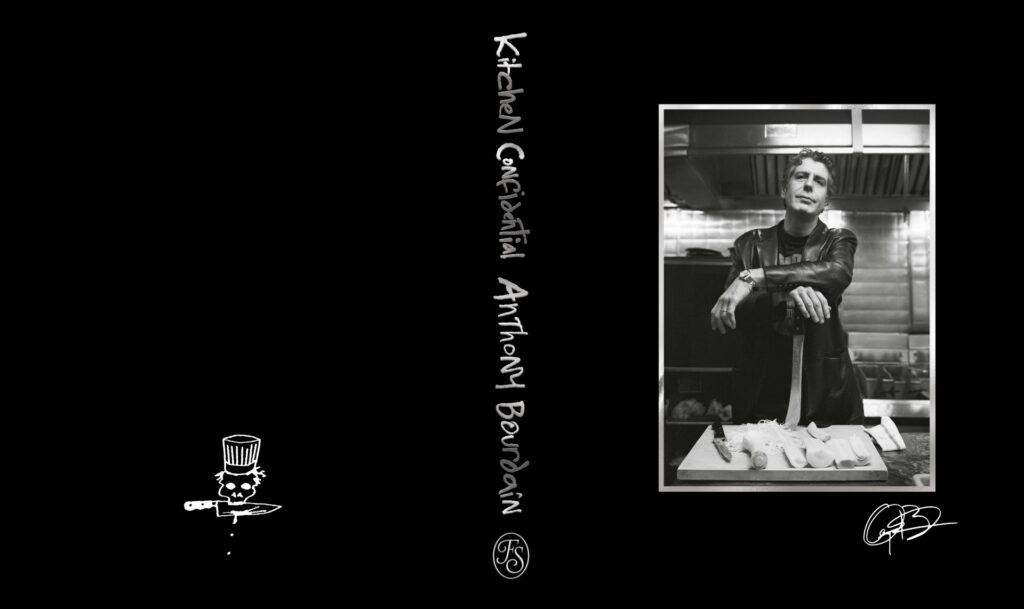
This month, the Folio Society released a deluxe edition of Anthony Bourdain’s memoir Kitchen Confidential. We’re pleased to share the introduction by writer and frequent Bourdain collaborator Joel Rose.
Tony Bourdain and I were friends for thirty-five years. I first met him in 1984. He was cooking in a little, gangster-run, South Village Italian restaurant. I was editing and publishing a little East Village literary magazine called Between C&D, and one day in the mail I received a hand-drawn, eight-page comic.
I always tried to write something encouraging, but truthful, when I rejected people’s work. I returned the comic, saying the art sort of sucked, but the writing . . . the writing was good.
The magazine Between C&D made an unexpected splash when it hit the bookstores in early 1984. The idea came to me out of drawing sessions I used to do with Celine, my three-year-old daughter. We started drawing together, scribbling over Sunday editions of the New York Times. Soon, however, we discovered fan-fold, dot-matrix, com-puter paper. The paper had a high-gloss sheen. Celine had colorful markers that all had smells: the red strawberry, the orange orange, purple grape, green lime, et cetera. The colors looked incredible on the shiny paper. They glimmered (not to mention, smelled good) and soon I was having great fun with my daughter drawing heavily influenced, blocky, hand-colored, pre-Columbian depictions of the wild explosion of people and types then currently roaming our neighborhood, the Lower East Side where we lived as a family on East 7th Street between Avenues C and D. Whence the name of the magazine. Ours was a dope neighborhood at the time. It’s what brought Tony over to my neck of the woods. To score C and D, coke and dope, over on East 2nd Street and Avenue C and then come up and see me. That was his plan.
Everything was happening all around us in 1984. Music, art, rock and roll. To my mind, the literary world seemed to be trailing behind. I had recently signed my first book contract. I immediately took the money and bought a computer, a state-of-the-art Epson QX-10. Back in the day, computers did comparatively very, very little, with emphasis on the word ‘very.’ Yet, when I look back, what a prize! I was Gutenberg. With my own printing press. My idea: ‘Hey, let’s put out a magazine!’ My wife and literary partner at the time, the French novelist, Catherine Texier, was all on board. We recruited a bunch of writer friends, none of them known or published, enlisted some downtown people already with local reputations, like Kathy Acker, Gary Indiana, and Lynne Tillman.
I drew each cover by hand. I printed out each issue in one continuous, fan-fold ribbon of pages. I packed them in zip-loc, see-through baggies, just like they sold coke and dope in the neighborhood. Things were rough where we lived. Cab drivers refused to take us home at night after we said, ‘East 7th Street, please. Between C&D.’ Nope. Too dangerous. The tagline that came to me for the maga-zine and endured through what became a legendary, yet transitory presence was the obvious, saw it every day: Sex, Drugs, Violence, Danger, and Computers.
Still, by the time I got home from delivering the first twenty-five copies of the magazine to local bookstores, Saint Marks and East Village, were both already ringing us up on the phone.
‘Sold out,’ each bookstore said. ‘Make more. You got something, kid.’
Just like that, everyone responded to what we were doing. We got everything from we love what you’re doing to death threats. Museums collected us: MoMA, the Guggenheim, the Whitney, the New York Times featured us. We caught Tony Bourdain’s eye.
Tony was desperate for an out, and he made no bones about it. A few days after I read his comic and sent out the rejection letter telling him his art sucked, the buzzer rang in my apartment and there he was, one very tall dude in chef whites.
In 1980 I lived in a tenement building on the same street my grand-parents married, my mother was born. In 1980 Catherine and I bought for $31,000 (US) four, four-room, railroad apartments on the top two floors of a once abandoned building. Catherine spotted the ad in the Village Voice. Her grandfather had left her a small inheritance that barely covered the cost. I had to bargain down the price at the last minute when we signed the deal (we settled on a final price in the back seat of a taxi parked outside the building because we couldn’t come up with the last thousand dollars). Before we bought in, the building had been used as a shooting gallery, only to be inevitably laid to waste by a fire. My friend, the late Nuyorican poet and playwright Miguel Pinero told me he used to shoot up in my apartment on a regular basis.
After the buzzer went off and I asked who was there over the intercom, I went down the four flights of stairs and found this very tall person in chef’s garb standing on the landing at the top of the stairs.
‘Hey,’ he said. ‘I’m Tony.’
‘I’m Joel,’ I said. He followed me upstairs, and we sat at my classic 1950s, yellow-enamel kitchen table looking out on the dev-astation of the East Village below and the Empire State Building in midtown, in the not-so-far distance.
We hit it off right from the start. Talked a lot of stuff, taking each other in. First look at him as he came up the stairs, I immediately saw he was pinned. He’d been out scoring and had succeeded in his ventures. I didn’t mention it, but I saw. I had been there myself. He talked about himself without prodding. We laughed about his drawings. How bad they were. On par with a talentless nine-year-old’s best venture, I kidded. Work was most reminiscent of the early 1920s-era Felix the Cat, not much more evolved than that, which could have been charming but was not. I saw right from the start, this guy was a monumentally, stressed-out, warm, witty, wonderful, big-hearted individual, not to mention, a natural story-teller. A little aside here. Tony did not always have that confident, self-assured Anthony Bourdain persona you saw on television. Early on, before Kitchen Confidential, he confided in me he was trying to learn to be a better public speaker. He said he was reading a book on the subject. The book said to use ‘k’ words. Sounds with hard cracks to gain the audience’s attention.
He said he was trying to adapt that strategy to his benefit.
That first day he stayed at my house, in my kitchen, for hours, until he had to return to his restaurant for evening rush. I told him I had grown up in the restaurant business myself. My father, a true Damon Runyon character, was a waiter at the Stage Deli at 54th Street and 7th Avenue. Owned and run by Max Asnas, the restaurant had been a late-evening hot-spot for entertainment folk and sports figures. One night, my dad got into a bit of a tiff on the floor. The manager (not Max) was poking my father incessantly, trying to get him to speed up. My father was having nothing of it. He reached back and took hold of the man’s finger and gave him back what my father deemed he deserved. He snapped the manager’s pointy finger, breaking it. The manager howled and my father moved up the street to the Carnegie, which Tony knew well. Had eaten there more than once. Even turned gleeful at the prospect my father may have waited on him.
Bottom line, back in those days, Tony and I were comfortable with each other, from the git-go. He confided in me how precari-ous things were in his life. Financially, professionally, emotionally. He was dead frightened he might wind up working the line in his late forties, fifties, later. The very thought was terrifying to him. He spoke of his confusion, his need to do something, his desire to accomplish something, write something, get shit out. We talked. Threw out ideas, traded stories. He said writing was scary. He said he went through fits and starts, and what to do about those was another matter. He said he had great terror with no idea how to mine it, use it, or harness it. He said he knew no other writers. I was the only one.
Over the course of much time together, Tony and I talked a lot of what writing was to each of us. We shared an array of emotion, thought, feeling. I shared my own experiences, the knowledge I had gained, the futility, the anxieties I had encountered and surely still did. I told him the most important lesson I had learned was there was a difference, a great chasm, between writing and publishing. One was entirely under his control. The other was not and would never be. I said I had developed a mindset. I thought of it as writing for the drawer. I said I tried to get my ideas down as best I could. Hold off judgment. Tear through it. Get into the music of it, get everything down in a fury, no matter where it was coming from, what the words said, how polished they were or not, how brilliant or how dismal.
Write from the heart, not the brain. Write from the heavens, write from the cosmos, write from the most distant star; write from your pain. I confessed to Tony, my whole life, people told me I was too much inside my head. ‘Get out of your head!’ my younger brother tells me till this day. When I did as I was told, when I somehow man-aged to turn the noise off, when I just wrote from my soul, let it flow, directly from that place inside of me needing worst to get out, when I reached that catharsis, that was when writing was really working for me. ‘Hey, man,’ I reminded him every time we lit on the subject. ‘That’s what being a writer’s about for me, that’s where I want to live.’ I was the first one to publish Tony. We worked together many times, through many books. Tony told me more than once, he owed everything to me. Not so. He was singular. A person unto him-self. From the day he climbed the stairs and walked into my life. I believed in his natural voice. I supported it and encouraged it. No matter where he was led, I didn’t want him to clean it up. I had gone to ‘writing’ school myself. Had studied at Columbia University in the city of New York and had a Master of Fine Arts (MFA in Fiction Writing). I went to ‘writing’ school to learn and now have spent my writing career trying to unlearn what I supposedly learned. I told Tony he didn’t need to do that. I told him to trust himself, to trust his voice. He didn’t listen to me and went anyway. Went off to study with the self-proclaimed master mentor, Gordon Lish, who didn’t get Tony at all. He came back to me, his tail between his legs.
Tony loved the Caribbean, particularly Saint Martin’s. Him and Nancy, his high school sweetheart and wife during those pre-Anthony Bourdain years, their life goal at the time would have been to live in a hut on the beach, drink frothy alcoholic drinks, have access to plenty of pot, and live out life with all its fulsome myriad delights.
By 1998 I had eaten in every restaurant and bar Tony had cooked in through the years. One Fifth, the Supper Club, Sullivan’s. Life had thrown some interesting turn-arounds in my course, and I was living with Karen Rinaldi, once friend and acquaintance, editor and publisher of my novel Kill Kill Faster Faster, later lover and wife.
Karen and I were not yet married. After being together for over a year, we had just had our first child. Karen was in the living room, completely focused, breastfeeding the baby. Tony was in Japan. He had written and published two novels, Bone in the Throat and Gone Bamboo. I held his hand through both. It was his first time in Japan and he was excited. He had just been to the Tsukiji Fish Market and wrote me an email while standing at his hotel window, gazing out at the city, the streets and wonder below. He described his time at the market with unbound humor and enthusiasm and delight. His note gave me such joy I wanted to share it. I rushed into the living room.
‘Karen, you have to read this!’
‘Joel, get away! Don’t you see what I’m doing?’
I said that I did indeed see her attention was elsewhere but wanted to share this delightful email I had received from Tony. I didn’t mean to intrude, I assured her. I only wanted her to enjoy Tony’s voice, his verve and delight and wonder. So, with her sitting on the floor, her back well-supported by pillows, breastfeeding our new baby, I did as I threatened, and read Tony’s email. Afterwards, she looked at me with dancing eyes and asked if Tony had other stories? ‘Oh man,’ I said. ‘Does he!’
Karen published Kitchen Confidential at Bloomsbury USA where she was editor-in-chief and publisher. After I read Karen the email, she immediately called Tony’s agent and put a deal on the table for an untitled book still to be conceptualized but based on Tony’s life experiences in the kitchen. The deal, she said, was on the table until Tony returned to the States. Tony’s mom had recently passed on a piece Tony had written for a downtown newspaper that had never acted on it. His mom worked at the New York Times and one of her colleagues was Esther Fein, whose husband is David Remnick, editor-in-chief at the New Yorker. The piece, entitled ‘Don’t Eat Before Reading This’ was scheduled for the Fall. When Tony met Karen at a bar in the Flat Iron District, he said he had in mind a title for his book. Note well, operable here, the hard ‘k’ and the hard ‘c’ Tony told me had been reading up on. Give the man credit, Tony was always a quick study. With a steel-trap mind. The title for the book, he proposed to Karen after his return to the US from Japan, was Kitchen Confidential. She thought it was brilliant.
Tony said to me once after everything had changed in a way that was so far outside our wildest imaginings that our friendship didn’t just belong to his origin story but endured the expanse of it all. He said he never saw in himself what I saw in him and he was forever grateful. I talked to Tony only days before he died, corresponded with him the day before. We were going back and forth, constructing the acknowledgements for our newest graphic novel Hungry Ghosts. When Tony’s agent (also my agent) called at 5:30 in the morning to say Tony was gone, I said, ‘Tony who?’
Having the opportunity to go back to Kitchen Confidential today, I cannot urge you strongly enough to make note of Anthony Bour-dain’s voice, before it became a public instrument, before CNN, before the Food Network, when Tony’s power lay in the precision and intimacy of his prose, in his ability to trust himself enough to speak from both heart and mind.
Joel Rose, 2026