
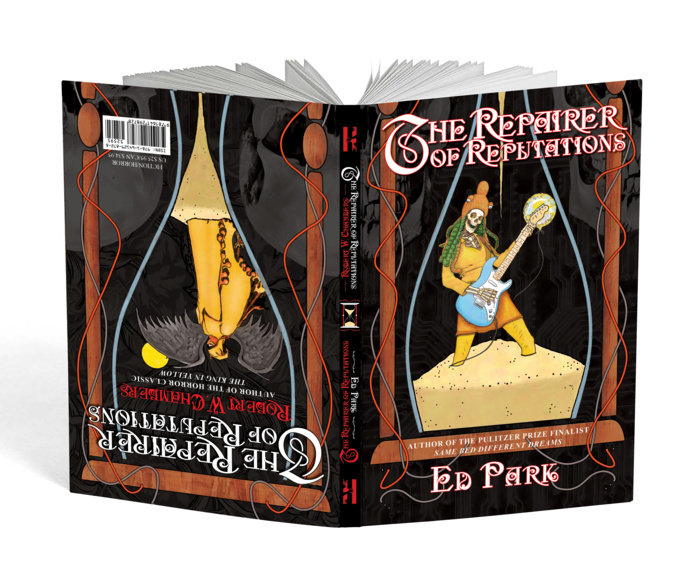
Robert W. Chambers’s visions of the future anticipated some things that have not yet come to pass, including personal booths intended for suicide. (Readers of Alan Moore and Jacen Burrows’s graphic novel Providence will also be familiar with the structures in question.) The title of one of his best-known works points to one of the things he predicted perfectly: The Repairer of Reputations. Nowadays there’s an entire industry dedicated to this; potentially industries, depending on whether you consider online reputation management and crisis PR to be distinct or interwoven.
Thus, this volume, which brings together Chambers’s original story along with a new one by Ed Park that takes some of the same concepts and brings them into the present day. Park also contributes an insightful introduction to Chambers’s story, noting the presence of a “well defended and beautiful and tacitly fascist” United States as its setting and arguing that the story “The Repairer of Reputations,” in a metafictional touch, can be read as a posthumous way to repair Chambers’s own literary reputation.
In Chambers’s story, narrator Hildred de Calvados Castaigne’s own encounters with a mysterious figure whose work involves — as the title suggests — repairing reputations ends badly for everyone involved. That story was set in what was for Chambers the near future: 1925. Park’s story, by comparison, is set in the here and now, in the wake of a haunting mass murder. The man who carried out this violent act is named Sid Feelings — which is also the longtime musical alias of the story’s protagonist, a singer and songwriter with a dedicated following of preschool-aged listeners. (Dan Zanes seems like a solid reference point here.)
If the multiple Sid Feelings seems of a piece with a book collecting two stories titled “The Repairer of Reputations,” that’s probably not a coincidence. Doubles and parallels abound here, contributing to the non-murderous Sid’s sense of paranoia. This Sid is also someone whose career has involved bargains with powerful entities — both through the use of a book called Simple Dumb Magic and through a restrictive contract with her first employer, which controls the rights to her early music.
Sid’s efforts to reclaim her good/non-lethal name brings her into the orbit of Chalker, the title character, here imagined as a kind of high-end fixer. Chalker’s instructions are specific and involve Sid staying off the internet while Chalker’s contractors carry out their work. So far, so normal — but there’s evidence that something about Chalker is slightly off:
As Chalker talked, she seemed to loom taller. Her neck looked longer, her eyes wider; sharp white teeth glinted under the fluorescent light. From the couch, Sid thought the Repairer of Reputations was the most beautiful thing she’d ever seen.
There wouldn’t be much of a story here if Sid did exactly as she was told, and it’s here that Park’s story turns even more surreal, creating the sense that Sid’s awareness of certain things is upsetting some sort of metaphysical balance. That’s where the narrative begins to break down, leaving Sid in a limbo of her own making. It makes for a good counterpoint to Chambers’s work — and an unsettling work in its own right.
***
The Repairer of Reputations
by Robert W. Chambers and Ed Park
Hell’s Hundred; 160 p.