I’m Adam Szym, cartoonist of many years and of late a hobbyist screenwriter. Last September my graphic novel Little Visitor & Other Abductions, a collection of three sci-fi horror stories connected by the theme of alien abduction, was released by Oni Press.
A few months before my book’s release I received a DM from Kris Bertin, the writer of the Hobtown Mystery Stories series, which is one of my favorite comics of recent years. He had realized that we both had graphic novels coming out from Oni Press in the fall of 2025 related to UFOs and aliens and had the great idea of interviewing each other about the books. You can read Kris’s interview with me here.
As a huge fan of the first two volumes of Hobtown Mystery Stories (I’m cool enough to have been reading since before it was in color) and someone eagerly anticipating the third I jumped at the idea, not least of all because it meant I’d get to read the new volume early.
I read the third volume of Hobtown Mystery Stories, The Secret of the Saucer, twice in preparation for this interview and found it just as compelling, hilarious, unsettling, and totally charming as the first two books.
If you haven’t jumped down the Hobtown rabbit hole yet I highly recommend it. This is a series I would happily recommend to chronic comics obsessives and non-comics readers alike, and one which I think teens and adults would find equally exciting.
Kris! I was really excited by the idea of these interviews. Let’s start where you started when you interviewed me about my book: the UFOs. I loved the design of the alien elements in this, they are totally otherworldly and are made even more so by the lingering question of whether they’re literally otherworldly at all. It’s certainly not a particular stretch to bring aliens into a setting like Hobtown, but what was it that made you want to fold them into the story, and what is your relationship to aliens as phenomena, as popular culture, or as iconography?
Thank you, Adam! Honestly, I don’t know why I’ve never thought of this before. To other artists reading this—if you have something coming out and so does someone you admire, interview each other! The questions will be better, and you get a first look at stuff you already want to see. It’s win-win.
Hobtown Mystery Stories follows a group of young friends trying to uncover the secrets of their weird little town, with special focus on colonial horror, curses, and regional folklore. I think the UFO subject would feel out of place in these stories if we had the extraterrestrial, first-contact kind. But we came to aliens through the lens of folklore. Alex (Hobtown’s co-creator and my illustrator) and I are less interested in what the phenomenon is than what it does, and what it means to people who experience it. The entire concept is so versatile, and depending on who you ask, UFOs are a source of hope and wonder, horror and trauma, or even money (as one character says, Saucers sell). In the story, we play with the iconography by using the 1950s “Adamski” style phony-baloney saucers, but when we’re really making contact with the inexplicable, we try to make it feel inexplicable.
This is actually closer to how I understand the topic as a whole. It’s an empty space, an inexplicable gap that people try to frame and explain with ideas like space aliens, time travellers, and gods. But whatever you call it, the thing is still happening. The “phenomenon” yields radar, physical data, and eye-witness testimony from the most grounded, serious people—like real life Top Gun-ass fighter pilots—whose reports are so physics-defying that what they see is more mouse cursor than spaceship, more ghost than science vessel. And the UFO stories from our little corner of the world, like the Shag Harbour incident, are so compelling. It’s honestly not good to read too much into it—to look at the serious stuff, like the works of Jacques Vallée or Leslie Kean—because it’s dangerous. It’s picking at the stickers on reality and peeling them off. Only there’s nothing underneath, nothing comprehensible—just utter confusion. And you sound insane when you talk about it, too, which is an added bonus.
I admire that the Hobtown books are unafraid to shake up the formula with each volume. The most obvious change between volumes is that each book focuses on a different member of the club as its protagonist, but there are other differences as well. The second volume, The Cursed Hermit, is a much more intimate and smaller scope story than the first volume, and takes the risk of pulling us away from Hobtown proper AND most of the cast of characters we’ve come to know and love. The Secret of the Saucer feels like a return to the scope, cast and setting of the first volume but with one huge formal difference: the story is told backwards. We’ll get to the backwards structure in a moment, but can you tell us about this tendency to shift the narrative or form and what inspires it?
I think the answer is twofold: For one, I like having a challenge. It’s difficult to radically alter what people expect you to do, and to give yourself a narrative goal like sequestering the cast in a new location or telling the story backwards is to dare yourself to see it through. In the same way that I try to come up with visual concepts that are compelling for Alex, like trying to incorporate surrealist sound imagery into speech bubbles, or make a hallucination take place inside a kaleidoscope, I want to have to do more than just map a few ideas onto Syd Field’s 3-act Foundations of Screenwriting and call it a day.
Not to sound like a brat here, but the other answer is fuck you (not you, Adam, I love you). But a royal, general one. We’re making art, and it’s weird and fun. We don’t receive notes, we have no producers, we aren’t in the business of making this more derivative of something more successful. We aren’t going to dumb it down, and we aren’t going to apologize if it’s not what someone expected. We are ourselves, and this is for us—but also for the reader who is like us. We like it.
Also, it’s worth mentioning Hobtown is detailed and subtle, but it’s not super complex, impenetrable stuff. This isn’t Finnegan’s Wake. And we aren’t the only pop culture mashup pastiche, either. If our version confuses or betrays the audience, go watch Riverdale, go read The Montague Twins, or return to the source material and use it as a device to interrogate your childhood memories. Those are all fine choices. But if you want one that actually mashes things up—and plays around in the juices and slurries that run off: Hobtown.
The first time I read the book in its intended way (which is to say backwards) and then read it again backwards (which is to say…forwards). This kind of formal experiment is a risky endeavor, and I have no doubt some readers will feel a bit of friction with it at first. I found that once I gave myself over to it and accepted the feeling of confusion and dissociation it had the effect of really putting me into the mind of Dana as her more down-to-Earth skepticism is forced to give way at the same time her social circle has begun to fracture and reform in a shape she’s not ready to accept. What prompted this experiment, and how did you go about executing it in a way that worked for the plot but also served the characters?
Thank you so much for reading it twice, and for getting it! We’re definitely expecting a certain amount of confusion (and repulsion) from the careless reader. But it’s not for them. I’ve had friends tell me that’s how they read it—front to back, then back to front—which I find to be quite flattering (in its thoroughness). We designed it to be read front to back, of course, the whole point of it is the experience of being thrown to the end of the story and absolutely everything being wrong and different and not understanding how you got there. And conceptually, you’re exactly right, it’s about aligning the reader with an overwhelmed and confused Dana, who is tumbling through the story like an amnesiac.
We aren’t the first story to do this, of course. There’s Memento and Time’s Arrow and (uh oh!) Irreversible, but the genesis of the idea came from asking the question of how we could make the story feel like an alien abduction. I was wondering if there was a way to make the reader feel like our Saucer-attacked townspeople do, like plagued with déjà-vu, unable to explain how they got where they are, and upset. Hopefully, our readers are all of those things, but also intrigued and curious. In terms of how we made it work, the story still had to be a story (all that Syd Field three-act stuff I dissed earlier is still, you know, vital), so the start of the book is still the start, the climax is still the climax, the ending is still the ending—even if it is all backwards. Emotionally, it’s building and building until you get to a point, a kind of waystation in the middle of the story, an oasis, where you (hopefully) begin to understand what’s going on.
As a cartoonist who writes but also draws comics I cannot allow another word to pass without taking time to talk about your collaborator Alexander Forbes. When I first discovered Hobtown in the black & white Conundrum Press editions I was floored by his work. I’d never heard of him before (seemingly nobody had in the scene) and his work has the quality of feeling casually made and effortless (though I know it’s FAR from that) in this very impressive way, like the drawings made themselves. It’s a very personal feeling mix of pure cartooning and skilled draftsmanship which is so enviable, to me. And the hatching, my god!
The young man is just so enormously talented, I can’t say enough about him. When I come to him with a script, everything is enriched by his art—the characters, the concepts, the meaning, the theme. Part of the reason I love this project so much and put so much of myself into it is because of him. Seeing his half of the work is the greatest joy. It inspires me and fills me with ideas. I see my own concepts on the page, but in his style, with his nuances and insights, with his small “acting” choices, and I understand it differently. It’s not simply realizing a project, it’s not like a director looking at dailies, it’s like an out of body experience—an out of story experience—where it feels like vitality has been poured into it, and the fiction has life. He is the lightning for my monster. Hobtown is Alex. There is no Hobtown without him.
Alex hasn’t worked on other comics, except for early, personal work, and the odd strip or two. He makes posters and merch for our local music scene, and on occasion does storyboarding for ad companies, but the graphic novel is a special, singular effort for him. I’m honoured to be a part of it, for real.
I understand you’ve known each other for a very long time, which explains how well the art and the writing harmonize in this series. If I was given a copy of these books without any cover or credits I would assume it was made by one person. Can you tell me how your collaboration began and how it has evolved over the years?
We’ve been best friends since we were six. In the first grade, another kid who knew Alex from Kindergarten noted my drawing skills, and suggested I go meet the other boy who also “could draw anything.” I did, and now suddenly we’re 40-year-old men on this journey together. We’re so close that we’re essentially brothers. Even if we have an argument or a big disagreement, it’s not going to change anything. We’ll see each other at our little office, we’ll get together with our families, we will continue on. In fact, as someone who grew up poor and without a very strong family presence in my life—up until I got married and had kids—Alex has been more of a constant than anything else. And seeing him now, with my little sons, as Uncle Alex, has been another unexpected reward for our friendship. I don’t know what would have happened to me without him.
Hobtown features a large ensemble cast of central characters but also quite an array of factions and parties involved in the plot, each with their own goals which are rarely fully clear to the reader. It takes a lot of confidence (or a lot of hubris!) to throw this much at the reader, but I think you’ve been very deft with all of the lore and world building. How do you approach the puzzle of packing this much in without overwhelming the reader, especially in this volume where the chronology is reversed?
We just put a lot of thought into it, had a lot of discussions, written a lot of notes. I have a good memory and just know who does what and where things go, even if it’s not clear to everyone else. It’s like being at a hoarder’s house. You go into their kitchen and it’s filled with heaps of trash and say, “Hey, where’s the salt?” and the hoarder goes, “Oh! It’s by the bucket of liquefying bananas, under the wet cloth on the box of diapers.” That’s me. I’m the hoarder: “Oh, Stephen Squash? His first appearance is in the background of the gymnasium in Missing Men near Tug Pinker, where his early affiliation with bullies is established.”
When I’m working with Alex, he comes to see it all in the end, even if he doesn’t understand at the outset. That takes a lot of trust, I think. But once he does see that it’s not all nonsense, Alex is able to hide his own little hints and references, further enriching all of these secret codes and affiliations. We do a lot with wardrobe, with colours, with dialogue, and even hand gestures.
You’re right, it’s not supposed to be clear to the audience. The point is that it’s unclear. But the idea is that it’s all there, that we’ve mapped it out, and once you’re at Book V and you’re a level 70 Chief Detective of Research and Mystery, you’ll be able to see it. From the very first page, we were referencing some far-reaching secret that you’ll understand one day.
Hobtown, the setting itself, feels very specific and fully realized, despite all of the surreal elements. It’s very clear from the first few pages of the first volume that the setting must be close to one or both of the authors. How close is the town to places where you and Alexander grew up or spent time, and what compelled you to set a story in that particular milieu?
We grew up in the middle of nowhere, in a place called Lincoln, New Brunswick (Stinkin’ Lincoln, we called it), and moved to another, different kind of nowhere, called Halifax, Nova Scotia. These places are unknown to the world at large, and only Halifax gets referenced in film and TV, usually as a place to represent the end of the world, or some distant land in between places. But to us, it was like coming home. Though we have a lot of complaints about our government and politics and economy, we still love the land, the people, and its stories.
It’s such a special place. It’s quaint and cute, but also dark. It’s also cramped, and so millionaires live next to the working poor, and they drink in the same bars. There’s a great, winding wilderness surrounding everything and steel-grey water beyond that—and underneath it all a history of blood and conquest that is utterly horrifying. A cowed people, brought here in droves and given stolen tracts of land so that we might assist in the extraction of wealth for our masters. A nation of people that stood strong on these shores for 10,000 years, only to be crushed by the cruelty of settlers. It’s gorgeous, and heartbreaking. It feels like the secret truth of our little world is everywhere, all around us, but just out of reach. It’s hard to articulate its magic exactly, but that’s what magic is. That’s what we’re after with Hobtown—a cursed, beautiful place.
I want to take a moment to talk about the color. I have to be honest and say I was very on the fence when I heard about the series shifting to colors when it moved from Conundrum to Oni. I’m a black and white comics partisan (almost all of my work is b&w) and Alexander’s art is so striking and raw in that mode especially with his incredible knack for textures and hatching. But I’m very happy to say I came away from The Secret of the Saucer quite impressed with the coloring, which is the right blend of naturalistic and cartoony, a mix which mirrors Alexander’s illustrations well. Why did you and Alexander end up choosing Jason Fischer-Kouhi as the colorist, and how did you all work together to identify the right coloring style and methodology for a series so defined by black & white art?
Zack Soto brought Jason Fischer-Kouhi to us, and the poor guy had to go through a lot. We put him through a lot, and he had to change so much. For him, the ocean is the blue pacific. For us it’s the poured-concrete floor of the Atlantic. We’re really particular about this project and spend a lot of time trying to get things right. And bringing in this whole new dimension to the story required even more scrutiny, and scrutiny for this virtual stranger’s work. We kept asking for more muted colours, more browns, more flatness, more softness. The pop of colour has to make story sense, a colourful flourish has to be earned by the plot significance, by weirdness. And everywhere in between we want things to be drab, realistic. The right colour. And then there’s tons of colour notes about what people would or wouldn’t wear, what was or wasn’t around in 1997, etc. To Jason’s credit, he did it, God bless him.
We don’t compare the two, they’re just different things. The colour editions are terrific, and they brought people to Hobtown who would never have visited otherwise. Black and white, however, will always be where we started, how it’s made, and how we think of it. We dream of being successful enough that we get a black and white omnibus, but…that’s a dream.
I think it’s easy to look at these books at a glance, especially the Conundrum Press editions, and identify them as Hardy Boys/Nancy Drew/Scooby Doo pastiche. They are that, in a way, but when I first found the series I was so impressed by how unimportant that initial aesthetic and narrative reference point ends up being. This is a series which wears its influence on its sleeves, but also never feels weighed down or beholden to them. It doesn’t feel cheap or winky with those elements, and ultimately finds a totally unique voice despite them. Three volumes deep into the series how do you view and approach these referential elements of the story and style?
In the early days, the Nancy Drew stuff was just a framework. Conceptually, we wanted our story to feel like what we imagined was inside those yellow books—not what actually was. Like if you let a kid look at a cover but not read the inside, what would they come up with? That was sort of where we started with it. In Alex’s earliest versions of the story, before I came on board, there was no Sam. Or rather, he was just a guy, while the others were analogues to different characters, and I was like—well, what about Tom Swift? Genius boy inventor, the guy the TASER is named after, and a proto-Johnny Quest who could bring a jet-set hyper-capitalist freak world along with him.
It’s not, however, the League of Extraordinary Gentlemen. They aren’t literally the Hardy Boys. They are characters like them, who draw from that history but aren’t powered by it. They are their own people, with their own flaws and quirks. Despite how weird things can get, the rest of the time we want people to be realistic. Part of that is taking those pulp guys and extrapolating what it might actually be like to be a Bobbsey Twin. Like making the Little Miss Perfect elements of a Nancy Drew type into a major flaw for her, or examining the neglect that would naturally result from having a father who is an adventurer.
But this is why there isn’t an elevator pitch for Hobtown. We’re always getting asked, but it isn’t X meets Y with a dash of Z. It’s its own thing. I see those other elements as part of its spirit (or “vibe” as the kids say), but not its beating heart.
Besides writing Hobtown you’re also a novelist and a screenwriter. How different is your approach to writing comics versus scripts or prose? Are your comic scripts very visually detailed or do you leave a lot space for Alexander to make those kinds of decisions?
I am very detailed in my scripts when I need to be specific. When there’s a compositional explanation of the scene that I can see and need to explain, I do. But if there’s a panel with two characters, I can just write Pauline and Brennan, and let him do the work of choosing what their faces and bodies are doing. It’s different from prose, in that it’s only the dialogue that gets read, so it’s certainly easier in some ways—you aren’t wrestling with commas and clauses and reading it out loud over and over. But there are other concerns: the composition of the page, of the number of panels and the flow of information, the choice to move away from a scene or stay, or what “shots” you’re going to use to evoke something.
Part of the fuck you from the above answer is that with Hobtown we have no bosses. Neither Conundrum nor ONI has made any dictates on what we can or can’t do. You can be as punk rock as you want in that situation. They want you to be, and you get to be. The fuck you is the point.
When you’re working in film, however, you’re a worker. You’re selling yourself, your ideas, your ability to build stories for other people, for bosses. And those bosses are not artists, so they don’t always get what you’re doing. The very best of them know that, but still trust you. The worst ones…don’t. They don’t understand what you do, and cannot do it themselves, and so sometimes they can’t articulate what they even want. So the approach there is yes sir and no sir. There is no fuck you. You are inside their machine, toiling, and you’re doing it for your family.
Well it was a pleasure speaking with you and getting to read the book early. I can’t wait for volume four (and five?). Until then tell us what else you’re working on or have coming up! Novels, screenplays…or what about other comics?
I recently turned in the script for Hobtown V (The Return of the Mini-Man), which is my last Hobtown script, so I’ll be able to work on other things soon. I just need to find an artist who can completely trust me (despite not knowing me) and utterly give themselves over to the project (despite it probably not paying off until years later). Sounds easy, right?
In film, we’ve got a lot of irons in the fire. If you ever see a movie called The Tip-Off, or Skip Tracer, or Helpmeet, or Headhunter, Kris Bertin (with his screenwriting partner, Naben Ruthnum) wrote them! If you don’t…they don’t exist, and never will. Our most promising right now is Road Test, a horror movie about a psycho driving instructor, which was picked up by Boulderlight (of Weapons and Barbarian fame). I’m also starting to direct myself and have written short films that I’m going to try to get into some festivals in the next few years. I just finished a novel, called THE INVASIONS, and I’m still polishing it (but you know, if you’re reading this and work for Penguin or Farrar, Straus and Giroux, email me).
But most importantly, the next book in the Hobtown series is getting illustrated right now. It’s called A Journey Into the Abyss, and it’s our adventure story, bifurcated in two narratives, like the Two Towers. It’s the tale of our heroes going underneath Hobtown to find Sam’s father, while back in Hobtown, a horrifying custody battle for one of the kids unfolds. It really sounds stupid when you explain that it’s a Jules Verne adventure story for boys and a harrowing courtroom drama, but that’s what Hobtown is. The idea sounds stupid—but we take it utterly seriously. I think it’s our favourite Hobtown yet, a pay-off to hundreds of little set-ups, a very emotionally challenging story, but maybe the most thrilling in the series.
And thank you, Adam, for the great questions. This was so fun! Go buy his Little Visitor & Other Abductions! It’s great!
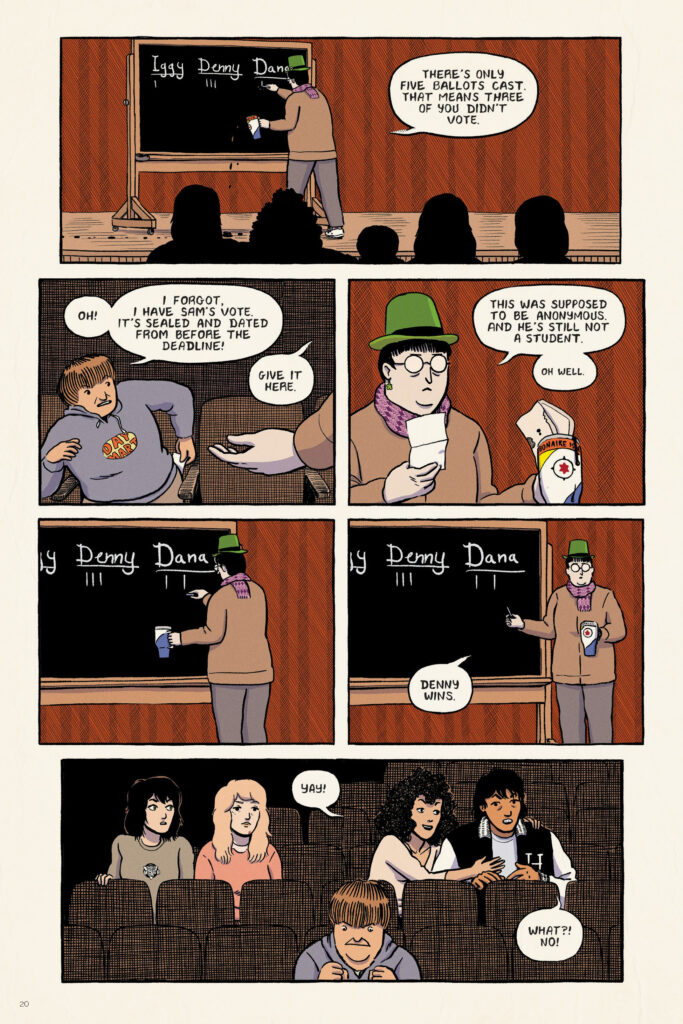
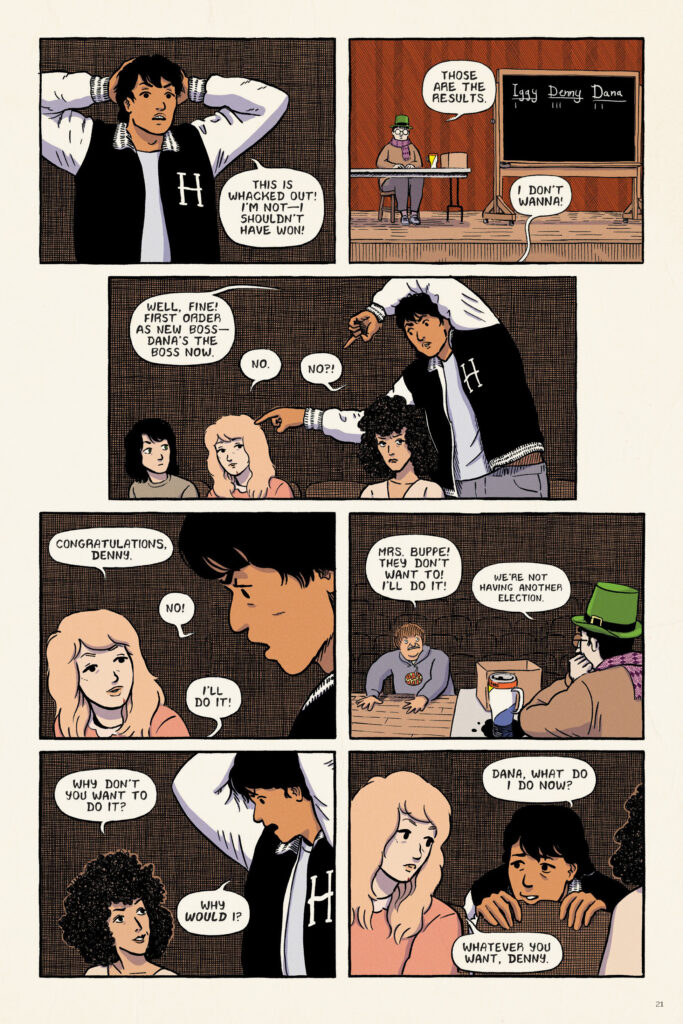
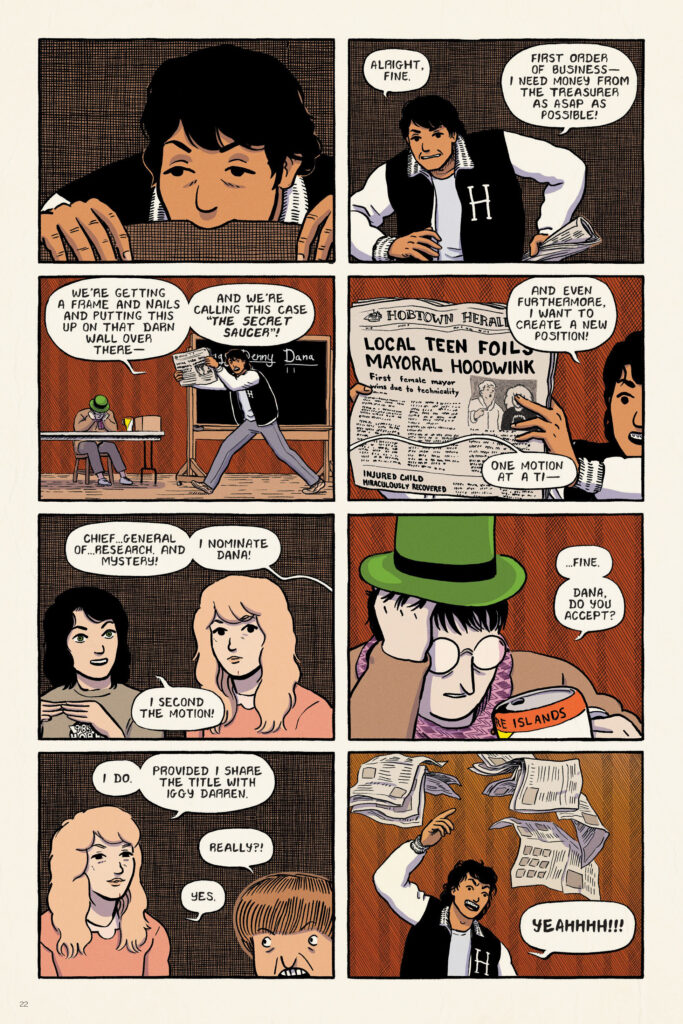
Read on for a preview of Hobtown Mystery Stories: The Secret of the Saucer…