
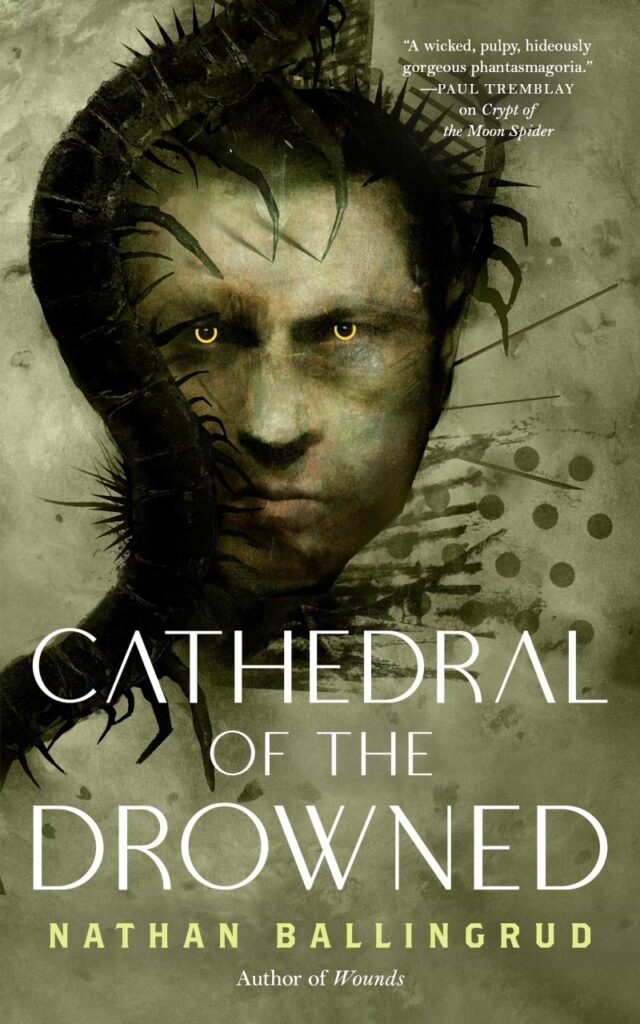
A Taxonomy of the Weird: On “Cathedral of the Drowned”

Cathedral of the Drowned

Ever since I first sat down with Nathan Ballingrud’s collection North American Lake Monsters, I’ve been enthusiastic about his work. The stories in that collection and its followup, Wounds, abounded with moments of dread both primal and existential. Film and television adaptations followed; then Ballingrud zigged when I expected him to zag, via the novel The Strange, set in an alternate past where other planets in the solar system can sustain human life without any sort of terraforming.

Continue Reading

Not the Locked-Room Mystery You Were Expecting: On “Enter the Peerless”

Enter the Peerless

Is the idea of a crime taking place in a locked room the most primal version of the mystery novel? As a young reader, I devoured plenty of mystery stories, beginning with the Hardy Boys and Encyclopedia Brown and graduating to Agatha Christie’s novels. Lately, I’ve been exploring the world of John Dickson Carr, whose mysteries also revolve around crime scenes that defy logical explanations.

Continue Reading

Love Potions for an Obsessive Age: On Mo David’s “Bring Your Lover Back”

Bring Your Lover Back

He’s Peter, she’s Wendy, but this is no storybook romance. From the first pages of Bring Your Lover Back, the rockiness of this relationship is palpable—even before the reader learns of the small velvet box stuffed deep in Peter’s jacket pocket. But Peter’s ability to delude himself sends him on a journey of desperate efforts to win her—or someone—to love.

Continue Reading

The Strange Rewards of “Diving Board”

Diving Board

You’d be amazed at how much mileage a story can get from a plant behaving like an animal, or vice versa. One of David Lynch’s early short films, The Grandmother, was about a kindly old woman who grows from seeds planted in the earth. Is it disquieting? Yes. And it’s no surprise that one of the most unsettling stories in Tomás Downey’s new collection Diving Board (translated by Sarah Moses) is about a horse that’s also a plant.

Continue Reading

An Immersive Take on London: On Sulaiman Addonia’s “The Seers”

"The Seers"

At the end of The Seers, Sulaiman Addonia reveals the meaning of the title. “Seers” are gender-fluid, trans, refugee outsiders. They are the traumatized, deracinated war victims who understand England better than longtime Londoners. In the words of the Seers, “We had to see ourselves the way we are from the inside first, from the moment we were born, before we learnt the rest of the world.”

Continue Reading

The Fiction of Art: On Emmalea Russo’s “Vivienne”

"Vivienne"

What does a real-life backstory matter in a fictional context? In an interview published by The Creative Independent earlier this year, Emmalea Russo discussed her novel Vivienne with Brittany Menjivar. Menjivar’s first question was about how Vivienne’s (fictional) title character was, in the novel’s universe, married to the real-world artist Hans Bellmer. Russo also noted the influence of the late writer Unica Zurn on the novel.

Continue Reading