
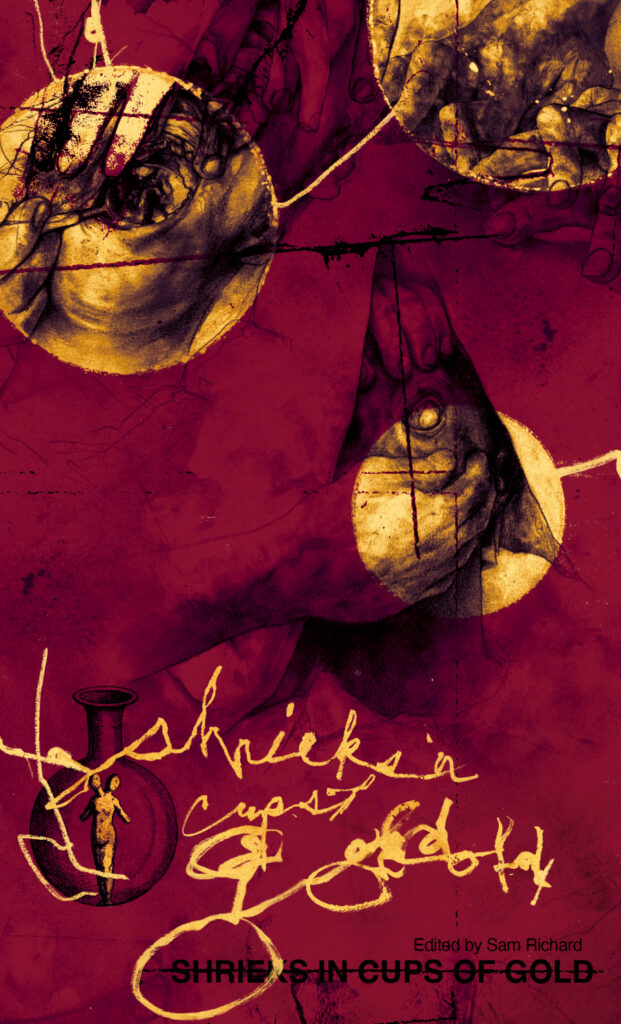
The last decade has seen an increase in works from Katherine Dunn’s archive seeing print, from her ruminations on profanity to a posthumous story collection. Dunn’s bibliography covers a lot of thematic territory, and while Geek Love is her best-known work, it’s far from her only book worth discussing. Also notable about Geek Love: among the accolades it’s received is a nomination for the Bram Stoker Award.
It isn’t surprising, then, that someone might choose to explore Dunn’s influence on horror writ large. Editor Sam Richard’s new anthology Shrieks in Cups of Gold includes just five stories — plus discussion of Dunn from both Richard and B.R. Yeager — yet manages to showcase how Dunn’s work can shape very different strands of, for lack of a better phrase, dark fiction.
Dunn had an excellent sense of how to convey atmosphere through prose, and Matt Brandenburg’s “Safety Features in Fabulon” is absolutely drenched in it. The narrator is obsessed with a particular theme park, the Fabulon of the title. They’re also fixated on the lives of the animatronic characters there, feeling that their idealized artificial society is deeply preferable to a more mundane and torturous existence. As the narrator carries out their plan, Brandenburg makes it clear where this is all headed, even as the narrative summons both empathy and disquiet.
The stories in this anthology feature different levels of realism and fantasy. Sara Century’s “Wet Dirt” involves a kind of recurring trauma, a haunting based around an action. (Specifically, being buried alive.) But the way this story’s protagonist describes alienation taps into a broader sense of being an outsider — something Dunn readers will know well: “Some places inside me have been hollowed out, while others have bloomed with a strange new life, unrecognizable to those who knew me.”
Other works collected here explore dramatic shifts in perception, whether built into the narrative or through altered states of consciousness. Brendan Vidito’s “Seventh Extinction” begins with a description of a grisly scene of disembowelment, only for a sentence a few paragraphs later to transform the reader’s understanding of that earlier scene. Much as Dunn prompted readers to leave certain narrative traditions at the door, so too do the writers gathered here — albeit using a panoply of methods.
In his introduction, B.R. Yeager describes the stories collected here as “dancing with the same dualities Dunn was known to weave and reconcile.” Readers unfamiliar with Dunn’s work but fond of the writers represented here — or of transgressive literature in general — will find a lot to savor. And if these unsettling stories redirect some new readers to Katherine Dunn’s bibliography, who’s to say that the roundabout path isn’t just as satisfying?
Shrieks In Cups of Gold
Sam Richard, editor
Weirdpunk Books; 116 p.