
Dostoyevsky had a roulette system. Fine-tuning his method in Baden-Baden, he wrote to his brother in 1863 confidently laying down the fundamentals of his infallible method, which, once you weed out the giddiness and guff, amounts to this: bet more, and if you lose, bet even more. Pile on more money, eventually you’ll hit a winning streak. Of course, as might’ve been expected, Dostoyevsky never retired on his roulette winnings, instead finding himself broke and forced to write his sketchy novella The Gambler in a few days to get out of debt. The Gambler is Dostoyevsky’s casino hangover, but the Russian giant’s ego being what it was, even so soon after his losing bouts at the tables in those European spa towns, he still glorified a little in the casino world that’d almost destroyed him.
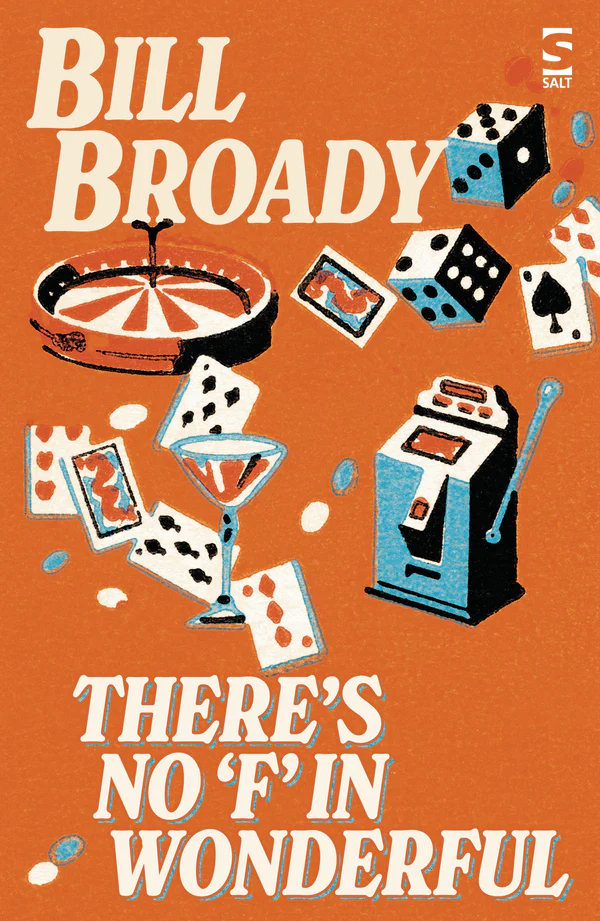
Travel now a hundred or so years into the future and we land in the bygone gaming halls of North Yorkshire, UK, in Bill Broady’s new novel There’s No “F” in Wonderful. Here we are at the heart of roulette and human appetite – no glorifying, not even in the muck – these gaming halls are Wiesbaden emptied of rich families and the spas themselves converted into lavatories with no flush.
There’s No “F” in Wonderful is Bill Broady’s fourth novel, coming two years after his epic The Night Soil Men, a kaleidoscopic exploration of the foundation and evolution of the Independent Labour Party in Britain at the turn of the 19C through to WW2. The Night Soil Men is a masterpiece of the empathetic imagination, leading readers into the mires of politics from the ground up through the flawed and fabulous minds of its heroes and villains. Few writers would dare inhabit characters as complex as Victor Grayson and Fred Jowett, fewer still could achieve such an uncanny grasp of their deepest feelings and motives. It’s precisely this uncanny eye and ear that brings the characters in Broady’s new novel to life also, characters still very much “this happy breed,” but in a 70’s Britain very much transformed from the New Jerusalem that closed The Night Soil Men.
There’s No “F” in Wonderful might have been, in less inventive hands, a social dissection of 70s Britain in Northern England. Instead, the novel is a sharp, coruscating antidote to inauthenticity and bullshit transcending its subject. What sets the narrator’s voice apart from the countless mythologisers of drugs, sex and gambling, is that he sees through their seductions, is hyperaware even while being entranced, so that we might even be tempted to call There’s No “F” in Wonderful an existentialist novel, a high-jinx The Outsider removed from the sultriness of Camu’s sun drenched beachy migraine to the shadowy parks and windowless gaming halls of North Yorkshire. Roulette is also a symbol of determinism and our illusion of control – Dostoyevsky’s infallible system, crashing out to the forces of probability – and the narrator is always on the brink of losing control, even though he is on the other side of the table. But Broady is too funny for the novel to fit into that camp comfortably. His narrator has no time for brooding. He is too hungry for living. We get caught in his infectious zest through descriptions of roulette players, of his colleagues, friends and authorities, presenting a cast of characters cut from Dostoyevsky and Leskov’s cloth; intensely present, so much so you can smell their adrenalin, appetites, obsessions, aspirations and disappointments. The roulette crowds are bare nerve-endings, constantly pursuing thrills that will never be satisfied. There’s No “F” in Wonderful is an atmospheric tour-de-force too: Broady’s casino pits, dank hotels haunted by thudding rats nobody sees, dusky parks with bushes of writhing bodies. Long after I’d finished reading, I felt trapped in these spaces, as though I’d seen them in a fever dream.
When the narrator switches from dealing drugs at the beginning of the novel to training as a croupier, he says: “It was amazing just how easy it was to change your life.” For most of the players in this novel though, their lives are pinging from one high to the next low with no more control than the ball in a roulette wheel. As a riposte to himself, as the novel closes, the narrator wonders of the femme-fatale Chris: “Had she discovered that whatever you were and whatever you did it made no difference?” This conflict, our dissatisfaction and constant desire for changing who we are and what we do, is one of authenticity, so, perhaps, after all There’s No “F” in Wonderful is in essence an existential novel, a raucous existential novel, Bill Broady’s antidote to the self under siege in 2026.
***
There’s No “F” In Wonderful
by Bill Broady
Salt Publishing; 272 p.