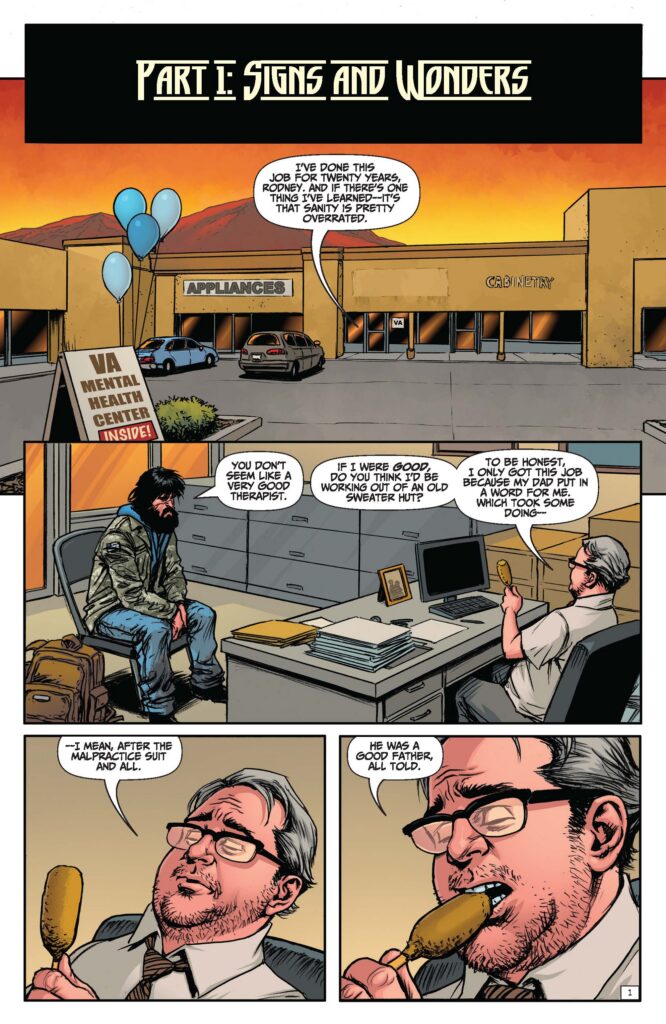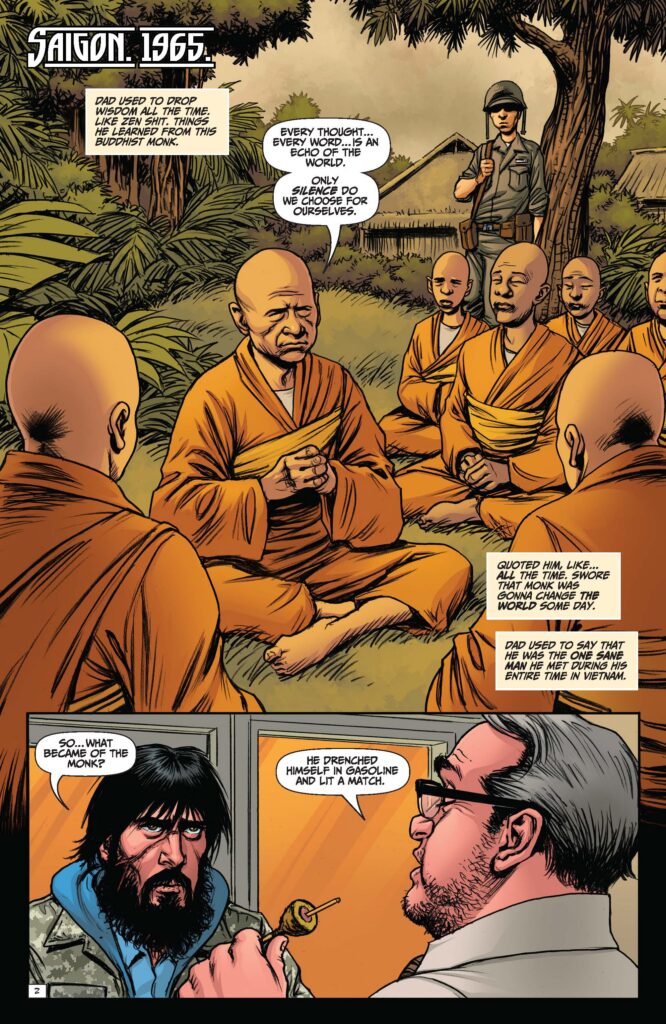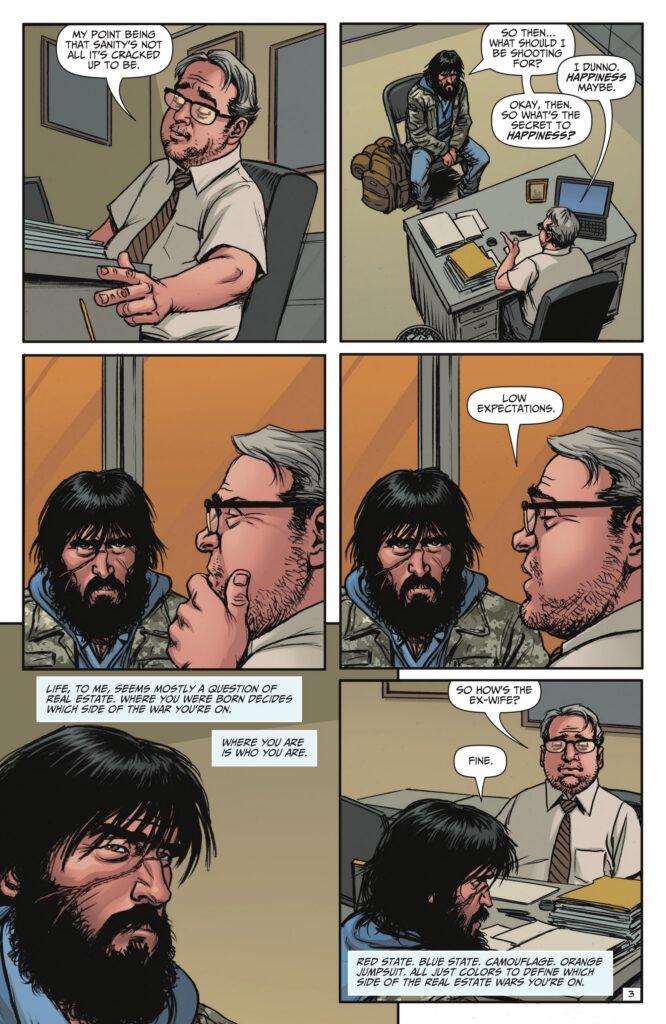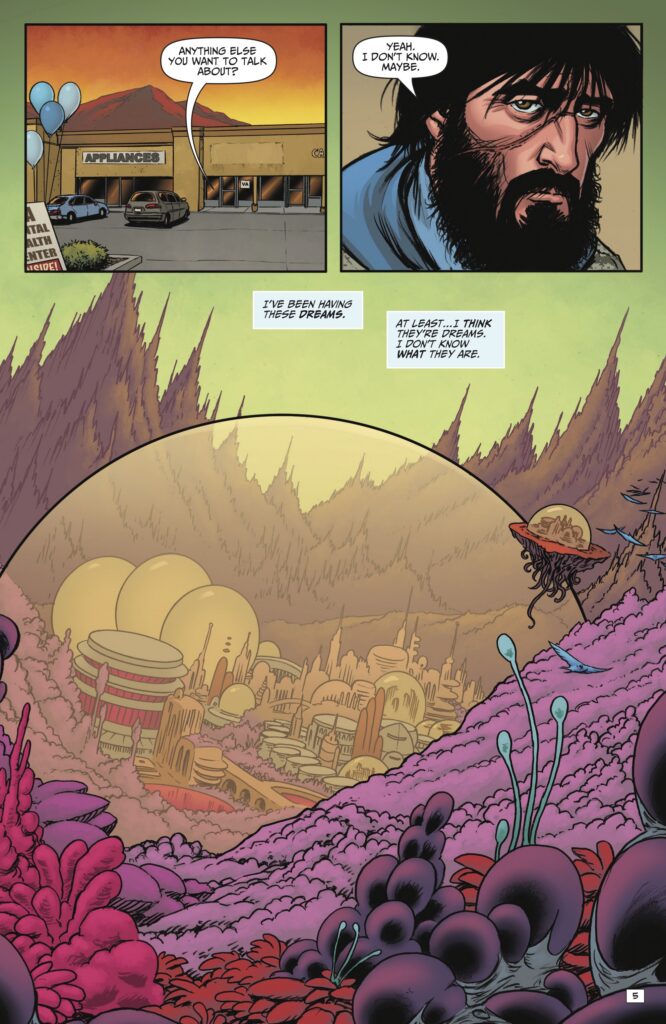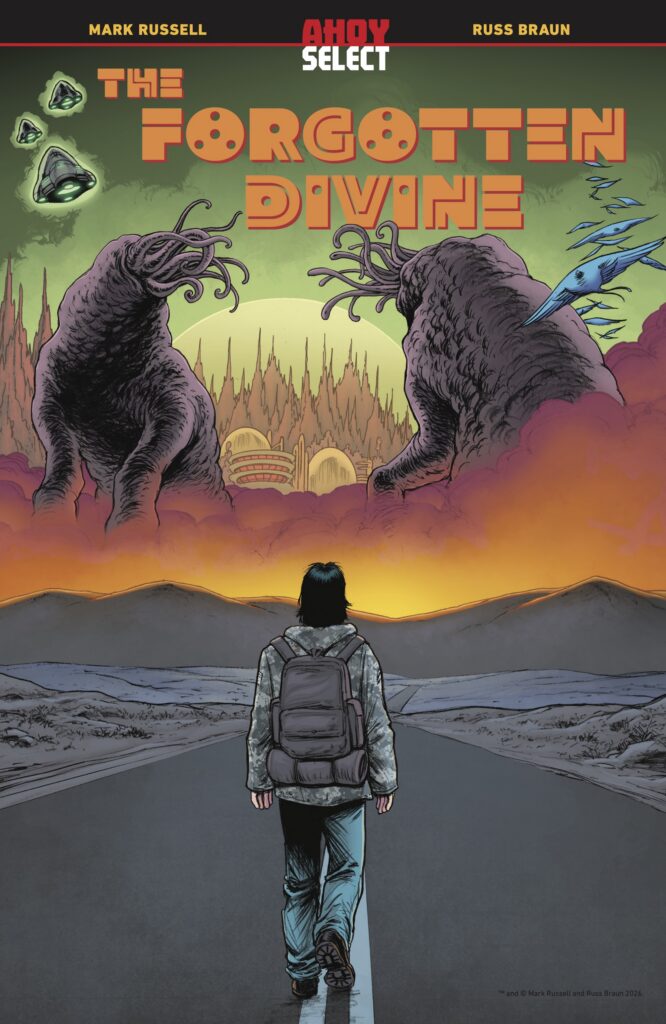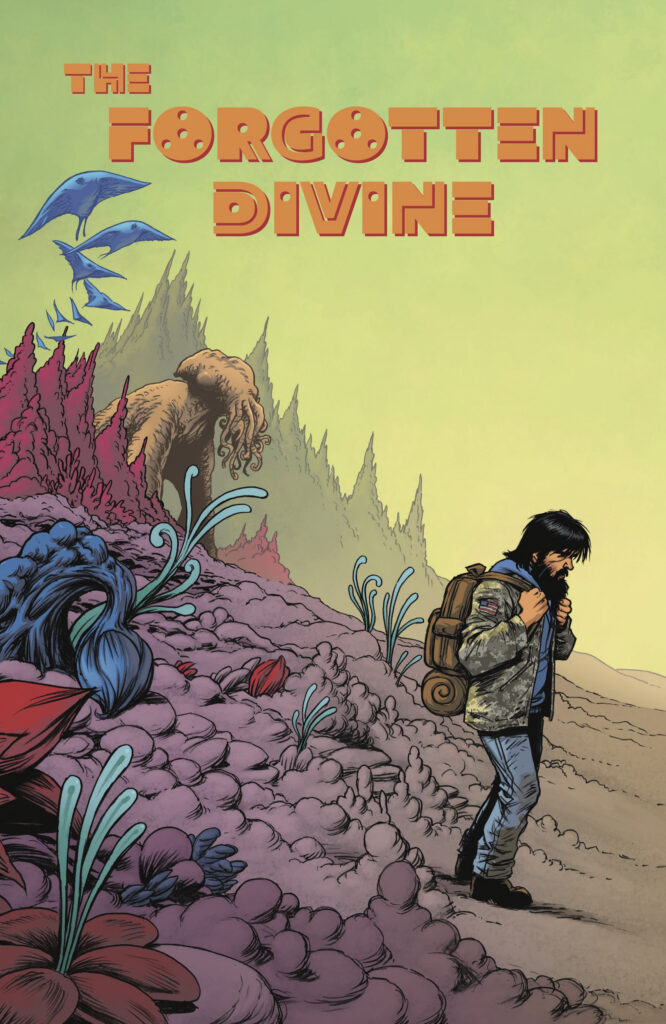
You might know writer Mark Russell‘s comics work through his Second Coming, which riffs on both divinity and superheroes; or through his reimagining of The Flintstones for DC Comics. His latest book, The Forgotten Divine, is a collaboration with artist Russ Braun, and tells the story of Rodney, a traumatized veteran who begins having visions of another world.
Is Rodney hallucinating? Is he tapping into something transcendental? This is a book where precisely what sort of story it’s telling is part of the mystery. With a Kickstarter campaign for the book set to launch soon, I chatted with Russell about the book’s origins, collaborating with Braun, and its unique length. Below our conversation, you’ll find a preview of The Forgotten Divine.
Did you have the story for The Forgotten Divine in mind before Russ Braun came on board, or was that something the two of you developed together?
Yes, the story was entirely written before Russ came onboard, which was a good thing, because it then allowed Tom Peyer and me to start thinking about artists who’d be right for it. Russ was a guy we were both drawn to because of how well he handles both gritty realism and off-the-wall visuals.
While most of the book is told in a realistic style, Rodney’s visions head into a much more psychedelic direction. How did your collaboration with Russ work for these sequences?
I gave Russ a few rudimentary sketches or descriptions of what I thought the characters and the aliens would look like and he came back with a fully realized world, adding physical details and dimensions that made every character feel unique and real and, simultaneously, made the aliens and their world feel more dreamlike, like something that could plausibly either be real or a hallucination, which is central to the mystery of the story.
There’s a lot of military history in here from the outset, including Rodney’s experience defusing bombs and his therapist’s father’s experience in Vietnam.
Yeah, the story is very rooted in the trauma of its characters and that of their society, which is a big reason why we as people and as civilizations reach out for alternate realities.
Throughout The Forgotten Divine, there’s an ambiguity about what the visions truly are. As a writer, how challenging is it for you to include an element like this where its level of reality is unclear?
The challenge is that, knowing from the outset what the answer is and how it is going to end, how much I should give the reader at each step of the way to both deepen the mystery while you unfold it. To me, as a writer, it’s almost the same process that the reader goes through in solving a mystery, but in reverse.
The Forgotten Divine is a short graphic novel. (Graphic novella?) How did you settle on this length as opposed to a single issue or a longer work?
One of the unique things about The Forgotten Divine is that we started with the story and then figured out what the length would be, which is the opposite of how comics are usually made. And I think it shows. This is a pretty tight story that I don’t believe needs any more pages, and yet, I can’t imagine taking any way. The result is that every panel in this story is vital.