
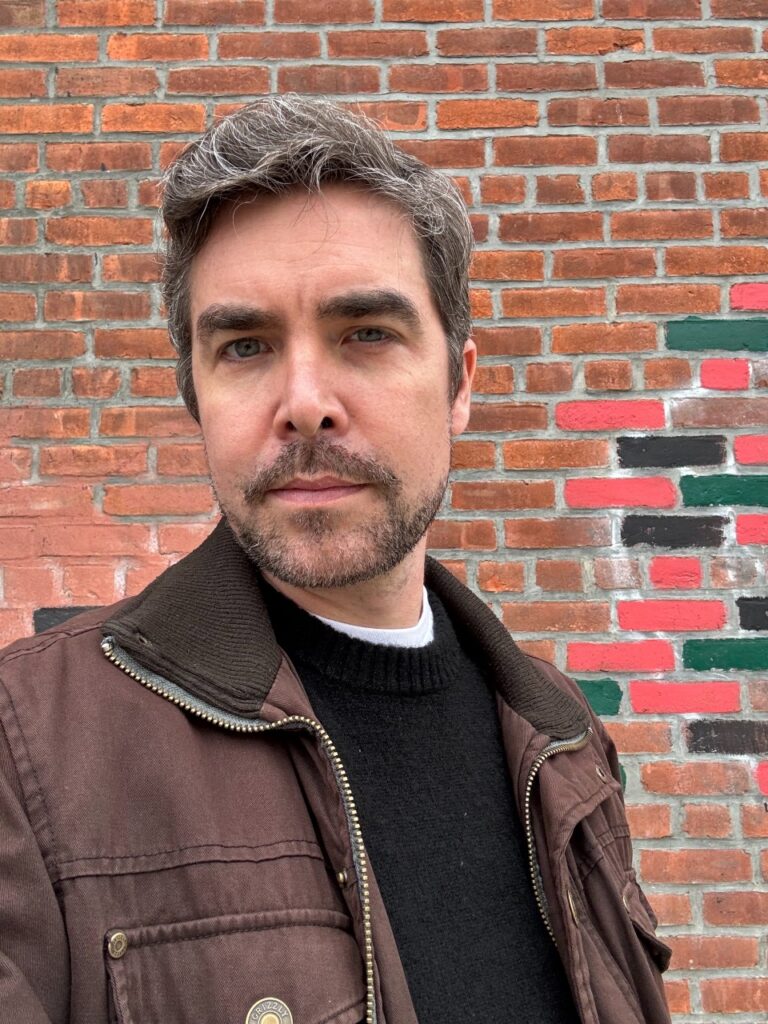
There’s a kind of transcendental experience to be had while watching the skies; there’s also a lot of isolation that comes along with it. In his new book Master of Starlight, DW Ardern tells the story of Olivier, an astronomer who calls a Moroccan hotel home. Gradually, Ardern reveals the reasons for Olivier’s de facto exile at the same time as two important figures from his past re-enter his life. It’s an evocative, unpredictable character study, and I sat down with Ardern over coffee to learn more about it.
What first drew you to telling the story of a reclusive astronomer living in the desert in a self-imposed exile?
I was in Morocco for about two months, and I was traveling around and basically heard about this astronomy hotel way deep in the desert. In Morocco, you have Marrakesh and everything that’s over on the west part of Morocco, and you have the Atlas Mountains that cut right through it. Once you get past the Atlas Mountains, it’s just the Sahara, and then basically leading up to the border with Algeria is a no-man’s land.
I was wondering why there was this astronomy hotel in the middle of the desert? Obviously, to see the perfect sky out there. I paid some dude $300 in cash for a rental car, drove through the Atlas Mountains — which is just terrifying, absolutely terrifying — and then ended up at this spot way, way out there, at the end of the road, in the middle of the Tinfo Dunes.
It was an astronomy hotel for both professional and amateur astronomers. And while we were there, I met this dude who was just this total weirdo, the resident astronomer of the hotel. He was such an interesting character, and I wondered, how the hell did this guy end up here? That was the point of departure. I know nothing about this person whatsoever, so hopefully I won’t be sued by him at some point.
You mentioned the drive to the hotel being dangerous — what was the reason for that?
The Atlas Mountains themselves. It’s an incredibly narrow road, as you’d see in Europe, and it’s on the edge of a cliff, and half of it’s broken off, and you have a bus coming at you. You’re playing this game of chicken to get there, and then as soon as it’s nighttime, you just have people in the middle of the road. These donkey carts emerge out of nowhere, and it feels like going back in time.
In Morocco, there’s basically a first world economy, a second world economy, and a third world economy. You could go to Marrakech and hang out in the French colonial buildings, the area outside the medina. And then there’s the tourist economy, the second economy, where people are doing things for the tourists or whatnot. And then there are just people living their lives in Morocco as they have for thousands of years. That does mean the price you pay for a bottle of water could be wildly different depending on where you are.
Earlier, when you were talking about seeing donkey carts, I was reminded of driving around western Pennsylvania some years ago and seeing Amish horses and carts on the roads out there. It felt like this strange blend of technologies.
It’s also interesting, because you have this character, Olivier, who grew up working class from European standards, and who contrasts with his rival Fritz, who’s had a very privileged life. There’s an interesting layering of privilege that happens in the book in terms of the collision of that. Olivier is kind of a screw-up, and constantly creates his own problems, but in his mind, he’s grifting to survive.
And, I mean, the fact that he essentially makes his livelihood just kind of out of happenstance, or just, like, he had a conversation with someone who said, “Come work at the hotel,” and he’s just been doing it ever since.
How did you find yourself writing about rival scientists coming from very different background in Europe?
I was really fascinated with a scientist who had the dichotomy of East and West. I really wanted to have this straight juxtaposition of a person existing within both worlds.
At one point in the book he goes to America and gets more into these woo-woo ideas. I was really drawn to that internal mental struggle of this character who deeply wants to be this cynical thinking scientist, but at the same time is a hopeless romantic, coming up with bespoke devices to measure things that no one has ever thought to measure.
It was a lot of fun to explore the astronomy of it. I got very deep into binary stars. The Beta Lyrae star system was the most fascinating one, because if you look at a picture of it, these two stars are rotating around each other and they’re literally trading mass and energy back and forth as they go. It looks like these stars are dancing. I mean, you can’t help but look at the night sky and feel some sort of reverence.
It’s an interesting paradox that some of the the same technological advances that have helped us get detailed images of distant stars have also led to more light pollution.
I can’t help but have some comedy in my books. That’s just the way that I write, just the way that I am. I love the fabulists of the 1970s: Gabriel Garcia Marquez and Tom Robbins and all those characters. There were so many times in this book where I thought there would be a purely dramatic moment and instead there was something really funny.
If the protagonist is this hippie astronomer caught between East and West and he has experienced the evolution of astronomy from 1970 to the early 2000s, when the book takes place, documenting some of those changes was really interesting. It was a wonderful thing to delve into, researching how to transmit data during the advent of the internet. Prior to the internet, they had ARPANET, which was basically a government-run system. Even the idea of studying the stars, grabbing the information about the stars, having it on a computer, then pinging it back up to a satellite in the stars to shoot it back down into the thing, there are all of these paradoxes.
What was it like to follow this group of characters over not just several years, but several decades?
I guess for Olivier, he starts out with such hope. He’s in academia, he leaves academia, and he becomes this sort of rebel astronomer working on telescopes around the world. The biggest growth is basically his relationship with Vera. This person becomes his fellow traveler, and there’s a romance without a single kiss, one of those classic romantic/platonic relationships. She is what keeps him grounded.
We have different parts of the story where they are together, and as soon as she is gone, he’s a little bit left to his own devices, tunneling further and further into his mind, and losing more and more hope on whether or not he will finally get his recognition in this world.
There’s also the point where that hope for recognition curdles into something a lot nastier in the final section of the book. How much of this had you plotted out versus letting the characters surprise you?
I try not to plot. I just throw some characters in a room and see what they do. I watch them surprise me; the choices we make in life, we oftentimes think we’re making the right choice, and we’re constantly fucking up, right? That’s what it is to be human, so I don’t want to think ahead on the choices this character may make until I put him in a situation, and then I really examine what he would actually do here.
Olivier surprised me many times with what he did, and that was greatly enjoyable. Sometimes it was difficult to watch him go through it. Like a lot of writers, I tend to become fascinated with a character and watch them grow.I try not to lock myself into any sort of great plot structure, because I don’t know whether or not that is going to be ripped up in the end.
This is a relatively short novel, but it also covers a lot of ground both temporally and thematically. Did you have a sense of how long the book would be when you began it, or was that also a surprise?
There was another book that I had in the drawer that was a much longer book. It was a braided narrative with multiple characters. When I put it in the drawer, I thought, “Maybe this isn’t the book to come out at this time.” I decided to write a straight-ahead, limited third-person narrative about an astronomer in the desert, and that’s all I’m going to do. No funny business, just going from point A to point B, and we’re done.
That kind of happened, but along the way, as the world built up, you just discover different things. You go digging into the backstory, his life, and his evolution, how he became this curmudgeon-y character. When I finished the first draft, I decided that I wanted to find out more about what makes this person tick, and that involved building out different parts of the world.
Do you tend to work on one project at a time, or were you juggling other longerform work as you were writing this?
I try to work on one novel at a time, because it makes me nuts to have multiple worlds open in my head. I have a book of short stories that I’ll try to get out there at some point, but mostly I’ve just been trying to sell this bigger New York book, which is a, which is a lot of fun, too. I was very excited that this book is out there in the world to say, hey, this is who I am. And it’s nice to see more books coming out that are a little more along the lines of illuminated stories, in a way. I like stories that feel a little bit like fables, and I’m excited to see that come back into vogue a little bit.
I’m going to put a spoiler warning here, but: the image you close the book out on, with these three characters who can’t quite escape one another — that feels like it has something of a fable to it. Did you have a sense from the outset that this would be where they all ended up?
Originally just had him walking off, and he’s done. But I think, fundamentally, there’s a love story here, and it’s a complicated love story. It’s a complicated love story involving some characters who, especially the men, are bumbling idiots. I would say that the ending serves the romance of the night sky, and so the underlying love story.
Since you went out to that hotel in the desert, have you had any other experiences with the night sky that have really stuck with you?
I go to Maine often, and it’s great to see the stars out there. To actually just see the complete night sky, and see the bands of the Milky Way there — it’s so profoundly illuminating to remember you live on this marvelous weird blue dot in the middle of this crazy universe. None of us know why we’re here, and we’re playing this game where we collect all the coins and die.
One of my favorite things in New York is the Amateur Astronomer Society. Have you been there?
No.
It’s the most classic New York thing. The Amateur Astronomer Society happens at the Natural History Museum, and they bring in astronomers, physicists, and whatnot, talking about the night sky. The people in the audience are from every walk of life you could imagine in New York. You can literally have a dude who works in construction who knows his stuff and has issues with the Higgs boson. It’s a reminder that we live in such a rich city of interesting characters where everybody is a thinker and everybody’s a dreamer.