
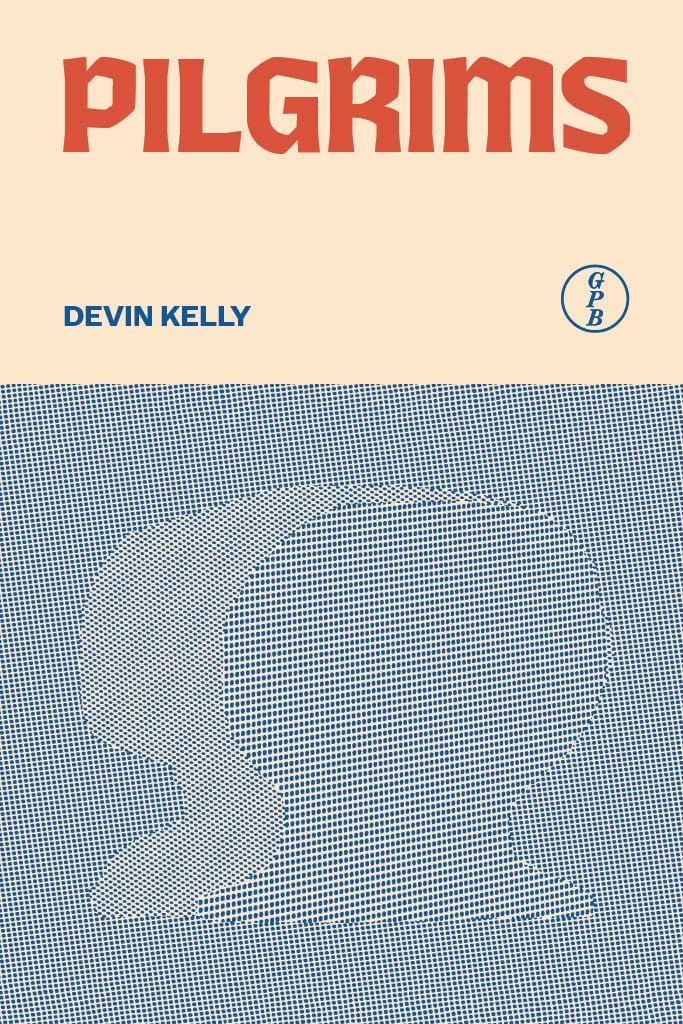
I have always highlighted and underlined sentences I like in books. Another writer once told me they loved reading after me because when they turned the page and saw something highlighted, it excited them. They knew a good sentence was coming. I don’t know if anyone would want to read my copy of Pilgrims by Devin Kelly, however. A little squiggle or star or swipe of yellow here and there isn’t a nuisance. But when damn near every sentence is marked up and circled with a yes! next to it, it becomes less charming and more like vandalism.
Pilgrims is a novel begging to be marked up, its lines etch themselves on your brain. It is the story of the Brothers Keene, Bobby and Billy. We mostly see the world through Bobby’s eyes—or Brother Keene rather, a truth-seeker and monk who lives and works baking bread at a monastery in upstate New York. Billy, his younger brother, has run away from home before the novel begins, which sets Bobby out on his journey to find him. Their parents haunt the edges of the book like specters.
As a writer, I often am overcome, as likely every writer has ever felt at one moment or another, with a suffocating anxiety that everything has already been written. What good have I got to contribute to the vast maelstrom of words our species has produced? What more could I add to the great works that haunt my shelves? In its technical aspects, Pilgrims seems to both ask and answer this question again and again. Every chapter is the question, and every line within is its answer. Over and over, Kelly packs a punch in his sentences, offering us gifts of thought and language entirely new.
Pilgrims captures what it means to be alone in a world in which we are seemingly never alone. More than that, it presents loneliness as something sacred and increasingly scarce—something that must be savored. Loneliness is both a religion and a salve from the harshness of the world. Before setting out on his journey, Bobby speaks with an elder monk, Brother Levis, who offers solitude as something akin to holiness:
“I sit alone each day, he said. I sit among others but still alone. I work near you and walk among the trees and sometimes during the day we all become one voice out of the loneliness of each of our singular voices. […] If I cannot renew loss, I might as well live as loss does. In constant ritual.”
But then, Kelly quickly turns around and hammers that same loneliness into armor. In one of his short vignettes, Billy contemplates loneliness as a shield when someone leaves: “[s]ometimes, the best defense against departure is to separate yourself from it.” And still, I cannot help but feel loneliness as a gift Kelly offers his reader. Each page becomes a chance to escape the noise of our world and sit in stillness. The novel is a meditation practice, a thousand prayer papers strung together, waiting to burn and release us from our suffering.
Yet, just when you think the contemplation might become too ornate—just when Kelly pushes the lyrical and philosophical to the brink of excess—he yanks you back and anchors you in the familiar:
“We often went straight from vigils to breakfast, which was served communally in what one might imagine to be some kind of Gothic nave of long tables and holiness, but really resembled a late-century Denny’s, somewhere between wood and Formica.”
Or, later, this line that turns over and over in my mind’s eye:
“Because instead of sea, I heard brother, and instead of fleddest, I heard rannest the fuck away.”
Kelly’s brilliance lies partly in this movement between the holy and the vulgar, the poetic and the absurd. He never allows the novel to float too far from the earth.
This book feels impossibly large for something so physically small. And the same is true of Bobby’s journey to find his brother, and of both the brothers’ attempt to find themselves. The novel moves gently rather than relying on dramatic plot mechanics, but that restraint creates a story that is intimate and genuine. It asks its reader to search within themselves as much as Kelly searches through language. Above all, it is a book that values humanity and room to breathe in a world that affords so little of that. At some point, I had to put down the pen and stop underlining. I had to simply sit inside the quiet space Pilgrims creates.
M.K. Rainey is a writer, teacher, and editor from Little Rock, Arkansas.
***
Pilgrims
by Devin Kelly
Great Place Books; 236 p.