

The Fastbacks provide go-to answers to at least two of life’s frequently asked questions. One of which is, What have you been listening to lately? It’s an expected question. I spend most of my waking hours listening to music and often fall asleep to records. I also enjoy talking about music. This combination would suggest I have some capacity for talking about the music I’ve been listening to lately. Yet when the situation arises my brain freezes, my current rotation blips away, and the Fastbacks swoop in.
***
I crawl eastward across Massachusetts driving toward central Maine. Somewhere in the gnarly mass of Friday night traffic, my brother Casey calls. He is also en route to Maine. We’re meeting up with our brother Pat at my uncle’s place in Bangor. Casey begins the conversation thusly: “Am I on speaker? Good. Go fuck yourself!”, and we laugh. Another dudes weekend is underway.
An hour later, I cross the Piscataqua River Bridge, which carries me from New Hampshire to Maine. I open the windows and take that first breath of fresh Maine air as was my grandfather’s tradition when returning from a trip away. I’ve been listening to a playlist of sidelong songs. But I need a different kind of energy for the homestretch, so I cue up For WHAT Reason?, the first new Fastbacks album in 25 years.
***
Answering “the Fastbacks” to the question of what I’m listening to made sense in the ‘90s when they were steadily releasing new albums. It made varying degrees of sense during the band’s lengthy hiatus. Still, they remain present. Maybe it was their balance of punk and rock, streaks of the Ramones, Buzzcocks, and Rezillos gelling with the influence of Queen, Sweet, and perhaps a dab of Montrose. Maybe it was the mix of genders among the band members. Maybe it was the lyrics, more earnest and wistful than most punk or rock. The Fastbacks often tweak their sound, but always sound like themselves. A scorching 90-second instrumental? Yes, total Fastbacks. A song with three keys changes or an extended eight-minute romp that opens with hushed vocals over a quiet keyboard? Equally, delightfully, just like the Fastbacks.
***
There are fewer road signs north of Portland and the traffic dwindles. The moon plays peek-a-boo behind the birch trees, and the haze of oncoming headlights hangs on the horizon long before the occasional oncoming car appears, like the Close Encounters of the Third Kind poster. Maine doesn’t look big on the map, but right now it feels endless and I feel I have all that space to myself.
Dudes weekend is the moniker we hung on our semiannual meet ups. I think I spitballed that one. We could have done better, but the name stuck. It was 2010. My dad and stepmom had just split up. Over the years, they had drifted from friends and were spending more of their time at home, which was odd for my dad; he had been such a social person. He was divorcing for the second time and about to live on his own for the first time in his 67 years. Worried he’d become a shut-in, my brothers, my uncle, and I planned a weekend with my dad and started meeting up at least twice a year.
***
The other FAQ for which the Fastbacks provide a ready answer is, What type of phone do you have? I honestly don’t recall the brand or model of my phone. I’d have to pry the case loose to find the details. But I put a Fastbacks sticker on the case, so if asked I tell people I have a Fastbacks phone.
***
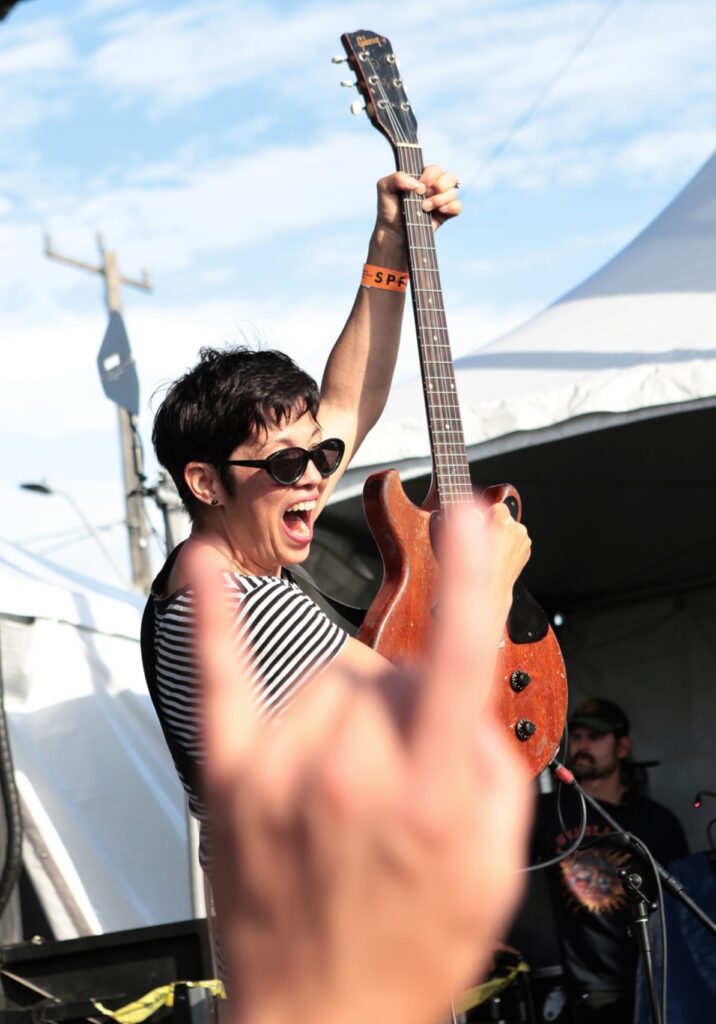
The Fastbacks pose another, more pertinent, question with the album’s title, which could be construed as, For what reason shall this mighty combo resume recording? A quarter century is a long time to be dormant, but the basic building blocks of the Fastbacks’ sound are still running clean—Kim Warnick singing lonely heart laments stuck to lollipop sweet melodies and Kurt Bloch’s guitar hero riffs. The songs remain restless with direct, unvarnished lyrics.
“Nothing to do today
Nothing to do tomorrow
No video
No stereo now”
– “Nothing to Do”
“Boredom is in full effect
and life is a total wreck
and I’m tired of everything but you”
– “A New Boredom”
That title, “A New Boredom,” implies a narrator so well-versed in tedium, they can see new shades in the proverbial paint drying on the wall. Yet despite the monotony, they’re still able to fend off cynicism and not lose sight of the good thing they have going with their sweetie. The Fastbacks’ motto seems to be bend, don’t break; brighter days lie ahead.
“Another quiet night at home
Another quiet night alone
Quiet night on my own
It would appear no one even knows I’m here
It won’t be this way for long”
– “A Quiet Night”
Or if not brighter days, then at least an eye toward tomorrow. Getting up and getting back to whatever the day demands. For WHAT Reason? should be recommended listening for Sisyphus, helping him gear up for each day’s boulder battle.
***
My dad was not known for drinking, but he got into the sauce the day we helped him move into his new house. As we unloaded the moving van, Dad started rediscovering treasures from the past—a mini squeezebox from the time he was an extra on a television show (The Merv Griffin Show, I think), a rock the size of his fist taken from what family lore tells us was a failed gold mine. He also found the trumpet from his high school marching band days. By this time he was too lit to help with boxes, so he stood in his new living room and tried to play the old songs. His sound wobbled as he reached for his embouchure, but he was in a good mood and the sound followed us as we went back and forth to the moving van. Every few minutes he’d pause and tell us about the rock again.
***
Paul Beatty’s The Sellout is a novel that defies easy summary. The city of Dickens, California has been unincorporated and erased from all the maps. The narrator wants to restore recognition for his hometown and finds himself working with the last living member of the Little Rascals to bring back slavery and segregation to Dickens. There’s much more, of course, but slowly and surely—and humorously and insightfully and horrifyingly—the unthinkable becomes plausible, or at least explainable. The Sellout is a work of genius. It has to be in order to pull off such a premise.
***
Another reason for the Fastbacks to reunite is “Come On.” Bursting at the seams with positive energy, “Come On” can barely contain itself. The lyrics boil down to “I’m in a good place—this moment serves me well, and yet I’m ready to leave, to move on. I need the next now!” “Come On” deserves to loom large in the Fastbacks storied discography. It’s Kim Warnick’s first Fastback writing credit since 1980, and she wrote the song after moving to Portland, Maine to get sober. (The video for “Come On” features the band zooming around town in a very practical electric car, which is more up my alley than snowmobiles. More on snowmobiles shortly.) The track is spruced up with handclaps, a key change, a tempo change, a double tracked Kurt Bloch guitar lead, and the pure joy of Warnick’s singing. She doesn’t get her due as a vocalist. Not that any of the Fastbacks get their due respect, but Warnick is up to her elbows in great records on which she’s sung lead vocals, landing firmly in some perfectly tough and tender place between Joan Jett and Leslie Gore.
***
We’ve continued the Dudes tradition since my dad passed away. We wind up in Bangor each January. We tour the local record stores and have come to refer to our favorites by the owner’s name. Dr. Records is “Don’s place.” Summit Sound has become “Gary’s.” I don’t know Don or Gary as the well-rounded people I’m sure they are. I know them only as veteran record store owners straight from central casting. Guys who pepper their conversations with pithy takes on musical luminaries. The Band? “They have a loose tightness.” Pianist Bud Powell? “Heaviest left hand in jazz.”
We feel comfortable in their stores, talking across the room and holding up records we think one of us will like or laugh at (Emerson, Lake and Palmer’s Love Beach or any Pablo Cruise album serve us well). Casey loves Oscar Peterson and John Prine. Pat is fond of the classics, especially Tina Turner, and keeps us current with Solange and obscure Icelandic bands. My uncle Steve lost his first record collection to a house fire in his twenties. He lost his second record collection to a flood in his forties. Now in his sixties, he says he’s preparing for locusts as he replaces old favorites, yet again, and makes space for new ones like Art Blakey and Grant Green.
***
About halfway through The Sellout, the city of Dickens seeks to form sisterhoods with various cities around the world. I was ready for a list of candidates to follow. But Beatty doesn’t just give us names, he develops evocative backstories over the course of two pages, including the Lost City of Male Privilege. It might be more elaboration than the situation calls for, and therein lies the beauty. Where other writers would quickly resume the narrative, Beatty leaps into a breathtaking swan dive of a digression, affirming and heightening the premise in ways that build a better story. Fastbacks’ guitarist Kurt Bloch demonstrates a similar flair in the riffs he writes and the solos he summons—virtuosic and purposeful. He recognizes and maximizes the space, however fleeting, that would benefit from embellishment, and he has the talent to tailor a just-right flourish. He might, maybe, on occasion, treat himself to a moment of “this is for me.” But even if it’s a tad too much, it’s still Kurt Bloch.
***
After the final record store of the day, we stake out a nearby bar. Tradition holds that we place our orders before we take turns showing off our loot; show & tell for grown ups. When in Bangor we head back to Steve’s and take turns spinning records. Last time we also pieced together that my dad wasn’t on The Merv Griffin Show, but Who Do You Trust?, Johnny Carson’s gig before The Tonight Show. And Steve shared floor plans for his new home that will be about 10 minutes outside of town. No longer will he have to schlep up two flights of stairs, and he’ll be able to crank his favorite albums without worrying about neighbors. I’m going to miss his apartment, the site of many musical adventures, but his excitement and optimism for his new house sweep away the nostalgia before it takes root.
***
I realize the Fastbacks hail from Seattle, but even before I learned Kim moved to Maine, I associated the group with the Vacation State because of snowmobiles. This stems from a band photo in 1996’s New Mansions in Sound. Kim is wearing a Skidoo jacket. I grew up in Central New York listening to the incessant whine of snowmobiles circling our neighborhood long into many a winter night, but I still associate sleds with Maine. That’s where I rode snowmobiles with my grandfather and my uncles. I can’t deny the rush of looking over my Uncle Carlton’s shoulder and watching the speedometer leap to 70 miles per hour. The wind whipping past my ears, trying to talk above the engine—it was like hanging on to a rocket. The Fastbacks traffic in similar thrills and For WHAT Reason? shows it’s still a blast to take the band’s distinctive sound for a few laps. It’s sat in the garage too long.
Thanks to the Wright Brothers at splittoothmedia.com for their helpful Fastbacks interview and Mike Powers for the Dr. Records/Band recall.
Mike Faloon lives in the Hudson Valley with his family. He contributes to Razorcake and Vol 1 Brooklyn. He also helps publish zines like Sonic Viewfinder, Submerging, and Zisk. For his latest book, he helped jazz legend Joe McPhee with his memoir, Straight Up Without Wings: The Musical Flight of Joe McPhee.
Photos by Niffer Calderwood – courtesy of Sub Pop