
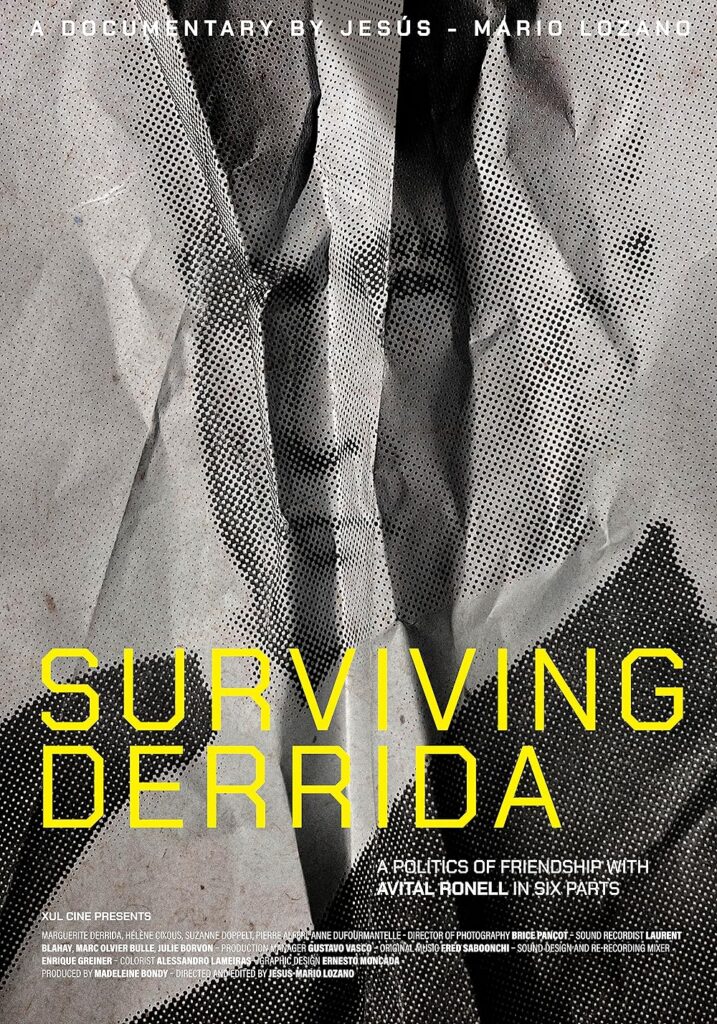
In recollections of her friendship with Kathy Acker, Avital Ronell writes, “Derrida locates in surviving the origin and essence of friendship. Not empirically or chronologically clocked but fundamental, the structure of surviving means that one of you will be left behind, responsible and responsive to the intemporal, irretrievably mute other.”
It is with this sense of the “the finitude that defines the friend,” the inherent mourning of each for the other without knowing who will pass first, that Ronell is concerned as she begins her odyssey on the streets of Paris seeking others of Jacques Derrida’s family and friends who, like her, have also survived him.
What is it to survive the precarious, endangering event that is the death of a friend, a loved one whose death both threatens and reinscribes one’s own existence? And what is it to have survived Derrida, Derrida’s death, this death among others?
For it is not only in survival and in memoriam to Jacques Derrida that Lozano and Ronell’s film is dedicated. Of the five survivors Ronell visits—Derrida’s wife Marguerite, Pierre Alféri, writer and son of Jacques and Marguerite, philosopher Anne Dufourmantelle, writer and photographer Suzanne Doppelt, and Hélène Cixous—three will be lost. Survival, the essence of friendship, requires a showdown with mutability and mortality. After Derrida, Ronell asks, “Isn’t friendship based on this terrible knowledge? The prescient knowledge: you must go, that one must go.”
Deliberately, there is no footage of Jacques Derrida in Lozano’s documentary. The film is not an attempt to capture Derrida as a presence, as in Kirby Dick and Amy Ziering Kofman’s 2002 film. Here, Derrida is his own différance, which is itself reminiscent of the relations of friendship, temporality, ineffability, and absence. We are brought into the contingency of the physical preservation of Derrida’s work, the possessions, the spaces, and ephemera that survive him. This is appropriate, for Derrida understood the ‘archive’ etymologically as commencement and commandment. Here the dilemma of the approval of the friend retrieves its ironic religious or occult aspect, one that will be revisited between Pierre Alféri and Ronell. Friendship, we will see, also commands its baptisms and ordeals.
Ronell describes the animal component of friendship, a companionship implying the animal gaze that interested Derrida. And this is taken up throughout the film, most explicitly in Ronell’s playful zoological dérive with Suzanne Doppelt. Doppelt, then writer in residence at the Ménagerie du Jardin des Plantes, affirms both the infinite distance and complete identification with the animal. The same harrowing and poignance are present in the anguished relation to the human other. The zoological panopticon precedes and human captivity, classification. Friendship evolves.
“What in a given moment makes a human being willing to risk his or her own life?” Of the survivors of Derrida who do not survive to the release of the film itself, Ronell’s visit with Anne Dufourmantelle bears the most profound unconscious anticipation, that prescience of separation. “Saving the one you couldn’t save,” as Dufourmantelle says, recalling the death of her then twenty-year-old best friend, possesses an uncanny quality given the later circumstances of her own death. Dufourmantelle died at 53, trying to save two drowning children; children who survived, or were saved without her having saved them. In their conversation, it is this existential relationship with risk that Ronell admires in her friend, unable to know where it will lead.
Deconstructing friendship reveals that friendship is precisely this: saving, preserving, loving, memorizing, recording, responding to, taking responsibility for/with, consciously and unconsciously archiving and memorializing the ones we cannot save. And we cannot, of course, save ourselves. For that, we need one another. We are, as Nietzsche says, animals that make promises, and friendship is such a promise, and a premise for other promises. Some promises do not survive, and some are unsurvivable. The promise of life is unsurvivable.
As the screen blackens before the fifth visit, indicating the necessity of her own survival kit, Ronell declares “I am still counting the losses. I have lost so many friends and essential interlocutors in the recent past, each one standing in defiance of enumeration, of substitution, as they fall, each one irreplaceable, a rebuke of my own capacity for survival.”
Hélène Cixous describes the survival of the relationship between the other and the self as “the survival of writing itself…pushing life to the limit of death. In fact, reaching out the hand to death.” Writing is a “dialogue with a wound that speaks. And it listens.” The wounded, resurrected spire of Notre-Dame is observed hazily across the Seine. Cixous articulates her friendship with Derrida, and this part of the film is the most straightforwardly political. One misses the presence of Ronell. We do not see her or hear her voice in conversation, and so the intimacy and dynamism of the previous visits is absent also.
We return with Ronell to New York, to her office with its images of Bette Davis and Joan Crawford, the Buddha, Kafka, Goethe, and Acker, training, struggle, matter, and what matters. Lozano and Ronell’s film is a subtle portrait of transmission, transference, tenderness, and gratitude. We are reminded that we survive through those who survive us, and the care they take with our utterances and our memories. It is important to approach this powerful, gentle film with this understanding. To survive is to live after, in every sense of living ‘after.’ I have seen Surviving Derrida several times now, and it continues to move me with its deep, learned, ongoing commitment to friendship, and to love, with all of its hard-won knowledge and numinous pains.
***
Surviving Derrida: A Politics of Friendship with Avital Ronell in Six Parts
Dir. Jesús-Mario Lozano; 2026
James Reich is a novelist and theorist. His most recent books include Skinship (Anti-Oedipus Press), Wilhelm Reich versus The Flying Saucers: An American Tragedy (Punctum Books), and The Moth for the Star (7.13 Books). More at www.jamesreichbooks.com