
No man in America has ever stood up so persistently and effectively for the dignity of human nature, knowing himself for a man, and the equal of any and all governments. In that sense he was the most American of us all. He needed no babbling lawyer, making false issues, to defend him. He was more than a match for all the judges that American voters, or office-holders of whatever grade, can create. He could not have been tried by a jury of his peers, because his peers did not exist.
Speaking these words from the vestry of the First Parish meetinghouse to the citizens of Concord, Massachusetts just two weeks after John Brown’s raid on Harper’s Ferry, Henry David Thoreau saved his cause. The raid had been predictably excoriated in the southern press, but papers in the North had also refused any robust defense of it, sheepishly admiring Brown’s devotion to the abolitionist cause while insisting on his insanity in attempting to incite a Nat Turner-style slave insurrection. Even Brown’s most ardent supporters had been silent in the aftermath of the raid for fear of arrest, with some going so far as to denounce it. If the narrative that won the day was that Brown had been an earnest but mentally unwell man whose fanaticism led him to commit crimes that would set back his own cause, he would likely come to be seen as one more obscure case of politically-motivated American violence rather than the catalyst of the Civil War. Thoreau had insisted on speaking that day, against the wishes of the town committees, and rang the bell to summon his neighbors himself when they refused. He began a tidal shift in opinion on Brown, who in a cascade of speeches and editorials came to be viewed in many parts of the North as a patriot and a righteous, plainspoken Christian acting in accordance with a higher law that self-evidently superseded reviled federal statutes like the Fugitive Slave Act. The staunch pacifist Thoreau saved John Brown’s mission of forcing an end to chattel labor through violent confrontation.
John Brown in turn saved Thoreau and his fellow transcendentalists Ralph Waldo Emerson, Franklin Sanborn, Thomas Wentworth Higginson, Theodore Parker, and others by giving their intellectual movement’s theories of a simple, spiritual life lived by intuition in rugged nature an actual embodiment it never would have found. They simply no longer made guys like Brown, with his old-time Puritan form of deep antinomian Christian belief and supremely matter-of-fact manner of speaking. He lived a subsistence lifestyle his family in the wilderness of western Essex County, New York.
Born in Torrington, Connecticut and raised in the abolitionist bastion of Hudson, Ohio, John Brown decided in 1849 to move his family to North Elba, New York to assist in a utopian experiment conceived by the wealthy social reformer Gerrit Smith, who had recently granted an unimproved 40-acre lot of land to around a dozen Black families each. Smith had provided very little assistance to these inexperienced farmers other than the cold, stony land itself, and many were struggling to find success in what came to be called “Timbucto” due to its distance from American culture and urban life. Brown was highly expert in raising livestock, and by then sick of failing in various business ventures, volunteered to help reify Smith’s vision of a self-sufficient, interracial farming community founded on principles of cooperation and equal partnership.
John Brown in New York: The Man, His Family, and the Adirondack Landscape by Sandra Weber (Excelsior Editions, 2025) narrates the Brown family’s life in North Elba before and after his death, showing how they took what was ultimately the narrowly-conceived pet project of a noble-minded but unfocused businessman and tried to wring out more emancipatory energies. For several years John and his wife Mary rented a tiny two-bedroom house for his family of nine, being sure to teach his children to appreciate God’s glory in the spruce-fragrant air and ragged mountains. “Everything reminds one of Omnipotence,” his daughter Ruth recalled him saying.
Weber provides short profiles of some of the Black residents of North Elba, such as Lyman Epps, who had been born free in Connecticut and moved to the area after living in New York City and Troy, New York. A grantee of Gerrit Smith’s, he lived in a log cabin with his family, raising livestock, later helping to found the local library and church and serving as an inspector of elections. Josiah Hasbrook, from Ulster County, New York, lived with his wife and five children, who went to school with the Brown children. One Hasbrook child, Josiah Jr., would later work at Brown’s farm. He considered moving west with them in 1863 but decided to enlist. He would have sung “John Brown’s Song” with his regiment having proudly known the man himself.
Seen as “a welcome and useful neighbor” by Black grantees, Brown sought to be of assistance even as he was frequently pulled to away to New England and later Ohio to resolve old debts. He used his experience as a land surveyor on behalf of Oberlin College to survey his neighbors’ lots. He helped to manage deeds, and occasionally went in on new land purchases with them. And he provided meals to anyone in need and held abolitionist meetings in the house his son-in-law Henry Thompson would erect in 1855 on Lot 95, and which still stands today as a National Historic Landmark.
“God is no respecter of persons,” Brown liked to quote from Acts. People assume that because Brown was an oddball Calvinist that he was probably always haranguing people for spitting, showing too much ankle, etcetera. But nobody could credibly accuse Brown of being prissy or judgmental, except regarding slavery, which he regarded as the deepest sin against God. His conviction in the commonality of all humankind was something he experienced as intense religious faith. This is very different from the nominal “believer” who, plagued by nagging doubt, tries to ward it off by fixating on what distinguishes themself from others. It is in the spirit of universal gospel, of inherent commonality that Brown and his family sought to live at Lot 95, in the shadow of the Adirondacks, as he withdrew from business concerns and refined his plans for a slave uprising in in the Alleghenies.
“Bleeding Kansas” called him away once more. In the wake of the Kansas-Nebraska Act, Kansas became a violent front in the South’s battle to expand slavery westward. He met up with several of his sons and successfully led a band of Quakers, agnostics, and Jews against pro-slavery militias. He also directed the gruesome execution of five proslavery men and freed twelve slaves in a brazen raid on a Missouri plantation.
Brown’s daughter-in-law Martha went to the North Elba post office one morning in October 1959 to learn from her neighbors that he was under arrest in Virginia. She heard these sorts of rumors pretty often though. But a few days later she returned to fetch the newspaper; she learned then that her husband, Oliver Brown, was dead, his brother Watson too, and that their father had indeed been captured by federal authorities. “My father had often spoke of the possibility of failure… but I didn’t not think failure possible,” Ruth would later say of the Harper’s Ferry raid. Her brother Owen had evaded capture.
Brown stood up to address the Court after his conviction of treason against the Commonwealth of Virginia.
This Court acknowledges, too, as I suppose, the validity of the law of God…which teaches me that, “All things whatsoever I would that men should do to me, I should do even so to them.” It teaches me further, to “Remember them that are in bonds as bound with them.” I endeavored to act up to that instruction…
Now, if it is deemed necessary that I should forfeit my life for the furtherance of the ends of justice, and mingle my blood further with the blood of my children and with the blood of millions in this slave country whose rights are disregarded by wicked, cruel, and unjust enactments, I say let it be done… I feel no consciousness of guilt.
By man’s law, John Brown was a convict who would shortly be sentenced to death by hanging. But he knew he had acted in accordance with a higher law that was legible not only to him but to everyone in the courtroom and beyond. The Southern press did a great service to his cause by printing the words he spoke word for word. He spent the weeks in his jail cell before his execution content, even joyful at times. He corresponded with his family and friends and received visits from admirers. His wife Mary came down to see him one last time before he was hanged on December 2, 1859. On his walk to the gallows, he handed his jailer a final prophecy. “I, John Brown, am quite certain that the crimes of this guilty land will never be purged away but with blood. I had, as I now think, vainly flattered myself that without very much bloodshed it might be done.”
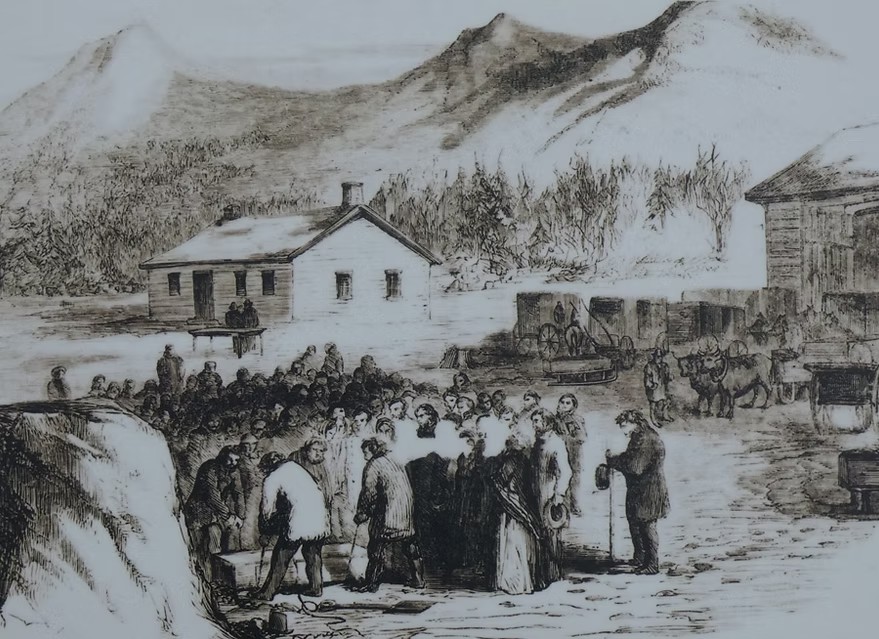
Though Virginians publically concocted horrific fantasies of what ought to be done with John Brown’s body, Mary successfully appealed to Governor Henry Wise to allow her to bring his body to the North Elba farm, as Brown had requested. This disappointed not only those in the South who would have preferred him mutilated, but several of his well-known supporters in the northeast who felt a funeral and gravesite in Boston would be better for the abolitionist cause. Mary was not able to secure the bodies of her two sons, Watson and Oliver.
He was buried at the farm on December 8. “Virginia stands at the bar of the civilized world on trial,” for her legal murder of Brown, eulogized the prominent abolitionist Wendell Philips. Over the past several weeks Brown’s martyrdom for freedom had been gaining wide recognition across the North, starting with Thoreau’s address in Concord. “God makes us all worthier of him whose dust we lay among these hills he loved.” In North Elba “he girded himself and went forth to battle… He sleeps in the blessings of the crushed and the poor, and men believe more firmly in virtue, now that such a man has lived.”
Numerous utopian communities of this era outgrew themselves, eventually being enveloped into the broader capitalist economy, but the vast majority failed to take off in the first place. Timbucto was a case of the latter; there were 50 or 60 Black people in North Elba in 1855, and less than two dozen by the start of the Civil War. Mary and the remaining Browns moved west in 1864, eventually selling the farm. But while W.E.B. Du Bois didn’t think much of Gerrit Smith’s under-baked plan, he felt the project couldn’t be seen completely as a failure. Indeed, the spirit of togetherness embodied by this wilderness community has served as inspiration to many of those engaged in struggles for justice.
The John Brown Farm today is a shrine to a peerless “great criminal” – Walter Benjamin’s term for the figure who breaks the law in such a way as to expose the violence undergirding it. His story may not fulfill the messianic hope for universal liberation, but it reminds us that such a hope remains possible.