
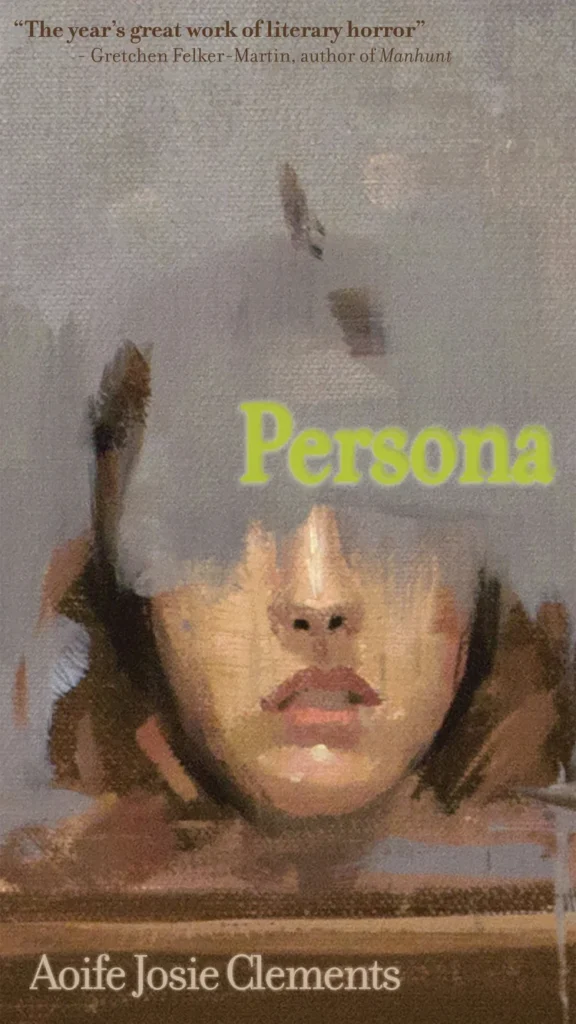
The more horror I read, the more I’m convinced of an inalienable truth: for a horror story to work, it has to reflect something that terrifies the author. That might be something as simple as an evil clown holding a machete, or it could be something abstract and idiosyncratic. Aoife Josie Clements’s Persona is firmly in the latter category, I suspect, but it isn’t entirely clear just how far its author is willing to go until its conclusion.
This is a novel to keep you up nights, but not for the reasons you might expect.
Persona begins with a section narrated by Annie, a young woman living an economically precarious life in Canada. Her work largely consists of filling out online surveys en masse for very little money; she’s deeply depressed and experiencing psychological fugues. Things get weirder when she sees a recording of what appears to be herself in an explicit video — something she has no memory of.
The narrative then shifts to Amy, who makes a living doing online sex work and who seems to have her life a bit more under control than Annie. There’s a desperation present in these sections as well; a sequence in which a possible client engages in sustained, demeaning harassment of Amy is as gut-churning and unsettling as some of this novel’s more uncanny elements. One other element links the novel’s two narrators: a company called Chariot Marketing Solutions, which is clearly up to something sinister.
The title of Persona has a few meanings and allusions, some literal and others not. There’s a section early on when Annie ruminates on the different personas that she wrestles with in her mind. Later, the narrative shows how Amy very literally maintains different personas: one for her online sex work, and another for her social circle in the city. And there’s the matter of Clements’s novel sharing a title with a certain Ingmar Bergman film in which two women’s personalities gradually blur together. And another sequence in which the two heroines go exploring recalls the climax of David Lynch’s Mullholland Drive, in which the identities of that films’s heroines have also begun to blur.
But there’s also something else afoot here: the matter of how Annie and Amy are one another’s doubles. And yet both have different family backgrounds; presumably, there won’t be a narrative rug-pull in which Clements reveals that both characters have been the same person the whole time. And yet there’s the similarity of their names: mush the two “n”s in Annie’s name together and you get “Amie” — something that doesn’t seem coincidental.
Both Annie and Amy are trans, and each one has a distinctive sense of shaping their own identity, their own destiny. The novel’s first sentence is “I used to feel like I was a part of something in this place, and now I can feel it drifting away from me.” That’s a statement of alienation that hits home on multiple levels, and that’s appropriate for this novel, where various forms of alienation — social, familial, economic — are all never far from the surface.
Writing about Persona is a challenge, because — for me, at least — much of the novel’s power comes from the mystery of where the book is headed. I’ll try to be as vague as possible with what comes next: this is a book that taps into something very specifically unnerving, which is to say that the pursuit of more knowledge could go terribly wrong. There’s a specificity to the turns that Persona’s plot takes in its closing moments, but there’s also something universally chilling in the way that things develop. In accomplishing this, Persona goes to an unsettling place few of its peers can approach.
***
Persona
By Aoife Josie Clements
LittlePuss Press; 260 p.