
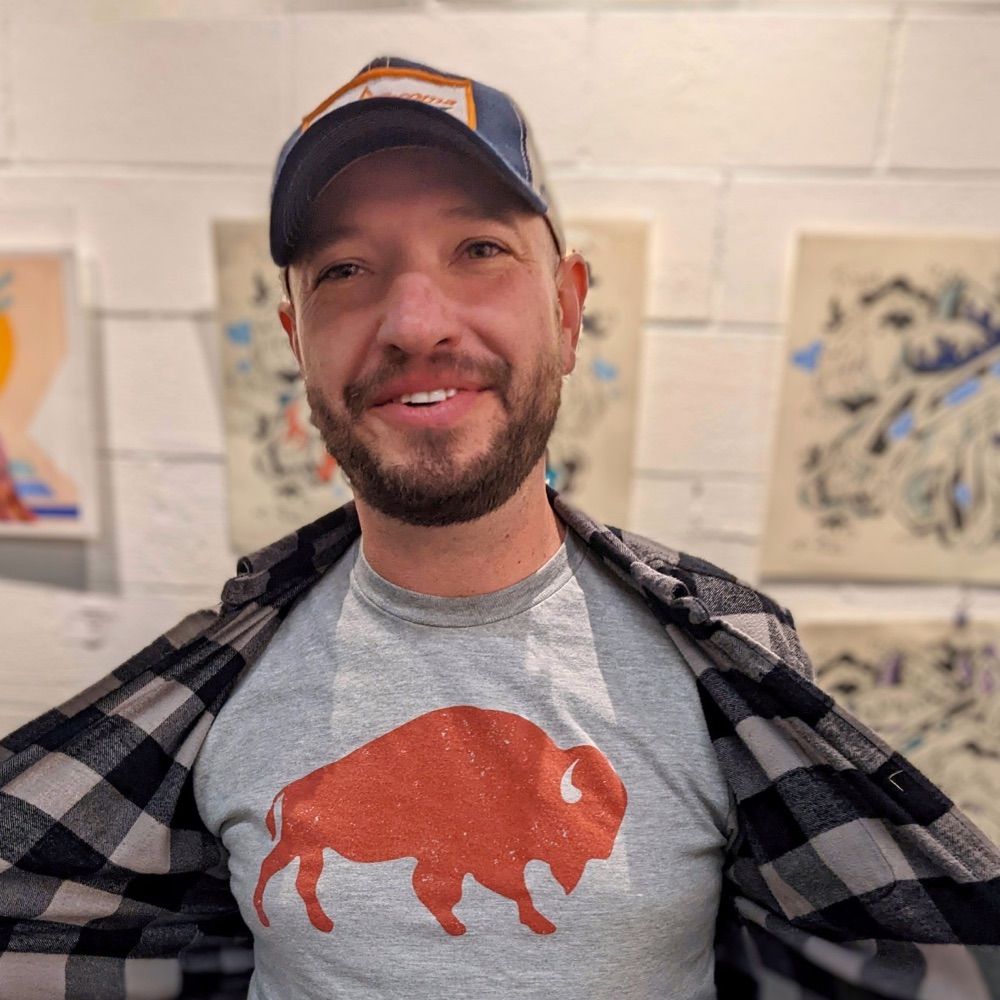
Much of Aaron Burch’s writing explores the myriad ways our past affects our present. Now, over two decades after founding the indie lit journal Hobart, and after publishing a novel, a novella, an essay collection, a short story collection, a craft anthology (and numerous short stories and essays, plus founding two additional literary journals), Burch is back with Tacoma, an autofiction novella that takes themes of nostalgia and the past to a wild new level.
How do you write an earnest story without being sentimental? How do you then toss in some speculative zaniness and make it all feel cohesive? In Tacoma, Burch has managed to craft a deeply personal, open and honest story that deals with change, beauty and wonder, but also has wormholes, hidden doors, pirates, and a literal nostalgia trip through a shopping mall. The result is a freeflowing, propulsive, hypnotic novella that takes Burch’s writing (literally and figuratively) to an exciting new dimension.
As a big fan of his writing, I feel incredibly fortunate to have had the opportunity to ask Aaron about Tacoma, the importance of writing “dumb fun short stories”, and the indie sensibilities that have shaped his work as both a writer and a publisher over the past two decades.
I love this quote from the “About the Book” description: “Blending autofiction with fantasy, meta with magic, and earnestness with absurdity, Tacoma presents a recognizable but also magical world where we ask, if nothing is real, then why not have as much fun as possible?” So, that’s an ambitious premise! I’m curious where this idea originated and how deep into the writing process you had gotten when you knew you could pull it off.
First off, book descriptions are funny. And hard! You don’t really think about it while writing (or, I certainly don’t; I don’t think most writers do, or at least not “literary writers”; I’d probably write more marketable, better selling books if I did!). I definitely never thought, “Here’s my premise!” and then feel like I had to pull that off. I just wrote the book that seemed fun to write, and then the book description was written after-the-fact, as a group effort between myself, the book’s publisher, Michael Wheaton; and the Autofocus editor who worked on it, Sienna Zeilinger. I don’t even remember how much of its language is mine, though I did know I wanted to try to capture and convey that it is autofiction but also speculative or magical or whatever, that it is silly but also earnest. I think those ideas are (hopefully) intriguing, and so grab a reader’s attention and make them curious, but also they probably just capture me and my writing (in general, but in this book especially).
The idea originated pretty close to what is conveyed in the (fictional) book itself — my girlfriend and I spent a summer in Tacoma. Her job is remote and I have summers off from teaching and I grew up there and it spending a summer where I grew up, around friends and family, seemed a fun way to take advantage of our summer flexibility. While there, I kept writing these dumb fun short stories, some of which were “autofiction” and some weren’t, some were set in Tacoma and others weren’t, some were more speculative/magical and others more realist.
At the end of the summer, Amber flew back to Michigan, and I drove back across the country with a couple of my best friends. If I remember correctly, it was on that drive that I had the idea of taking a bunch of the short pieces that felt most similar and edit them together that I could then fill out into a larger narrative. I didn’t look at the stories themselves and reread through the lens of wondering if they could actually be puzzled together, but at least in theory, it felt possible. And kind of exciting! And then at some point I had the idea of calling it TACOMA. I had just spent these two kinda magical summer months in Tacoma, and I was in the car with two best friends and we’d all grown up together in Tacoma, and so having a book called that seemed fun. And it made me laugh. And I thought it sounded like a good title. And once I had that in my mind as a title, it seemed like it could be a book.
I’m a firm believer that writing “dumb fun short stories” can only lead to good things, (even if those stories don’t go anywhere). But here, they did! On a project like this where you’re starting out just having fun, then the story finds its shape and evolves into something bigger and more meaningful, balancing that earnestness and silliness is tough. For me, the language really brought it together. The writing is so honest and casual and conversational, and all these wild speculative elements are treated with this cool nonchalance that makes it such a balanced, almost hypnotic read. Did you see this narrative voice as a way to bridge all of these story elements, or did it develop naturally as you started connecting these shorts you’d written?
Me too! I think my best writing often (always?) comes from when I am having fun… which is kinda obvious, but also can be weirdly hard to do? I think there can be such a pull, when writing, toward what a story “should” do or sound like or be, and I sometimes have to remind myself that it can do or sound like or be whatever I want!
I think most of my writing is casual and conversational. That description maybe comes closest to defining my voice or style, insofar as I have one that is recognizable. Sometimes from reading aloud, and sometimes just reading and rereading and rerereading on the page, I am often trying to push toward what feels most natural, what feels most like I’m just telling a story to friends. With this, I was really wanting to keep it as loose and fun as possible.
I think “DT Only Reads My Stuff If It’s Really Short Because He’s a Baby with a Wife and Kids and Adult Responsibilities Blah Blah Blah” was the first thing I wrote in Tacoma, and then I wrote “Maps” a day or two later. They’re pretty different, but also both have this short, kinda choppy, loose voice and structure that just felt really propulsive when writing that I hoped made them similarly propulsive and engaging when reading, too. By the end of the summer I’d written… I don’t know, probably a dozen short pieces. Maybe half of them had some version of that voice (and another half didn’t) and so a part of that narrative voice that was bridging all of these story elements was me just recognizing which stories felt similar and could be pulled together, and so once I did that, I had that voice and kept going, filling out the whole.
On top of all that, I think the “wild speculative elements treated with this cool nonchalance” was in part because I was having such fun with that loose, conversational voice, and also having a lot of fun writing about this autofictional version of myself, and my girlfriend Amber, and my buddies Kevin and D.T., but also I’m not that interested in autofiction, and so playing with magical, goofy, speculative elements in this casual autofiction-y way just felt fun?
Yeah, the “pull” toward what a story should “be” is so easy to get hung up on. This idea of allowing yourself to have fun and to push toward the most natural voice possible feels like a good segue into the next point I want to ask you about: indie publishing. Tacoma is your third book with Autofocus, and all of your other books are also published by indie presses. I’m kind of embarrassed to admit this, but the whole world of small, indie press books is fairly new to me. As with indie films and music, I imagine indie publishing allows you, as a writer, more freedom to pursue a project like this, (i.e. something you wrote because it was fun, different, interesting). I wonder if you could talk about what you feel like you’ve gained as a writer publishing with indie presses, and what you might say to readers who are unaware of or are just starting to explore stories from smaller presses?
Oh man. I feel like I have either too little or too much to say about indie presses!
I’m kinda the other side of the coin as you with the world of small, indie presses. As you note, all my books have been on indie presses, and my whole life of writing and publishing came through starting an indie lit journal, and so it all just feels very much my world.
On the one hand, I am incredibly curious about bigger presses and would love to have that experience, if only by way of comparison, and also there’s advantages of distribution and exposure and just getting books out there and finding more readers. Back in my first answer, I mentioned not thinking about book description when writing… though “I’d probably write more marketable, better selling books if I did!” Which is a little jokey, but also true. A bigger press would probably sell more books, but the book they’d be selling more copies of would be a more “marketable” book.
On the other hand, as you note, similar to indie films and music, indie publishing probably allows for more offbeat, unique, hard-to-categorize, quirky stuff. My first real fandom was hardcore music as a teenager, and I think that helped form my DIY sensibilities and the power of art that is more independent and punk. I think indie presses have given me that freedom to just chase whatever interests me, which it turns out often isn’t as marketable or sellable or whatever, but is what I love about writing and art, it is what excites me.
I always wonder if established writers reach a point where they feel like they can more easily push their own boundaries, maybe chase those interests with a bit more fearlessness than when they were starting out. Do you feel like you could have written a story like Tacoma earlier in your writing career? Another way of asking this might be: what did you have to learn (if anything) before you felt like you could write something like this?
Oh, this is a great, interesting question!
I don’t feel like I could (or would?) have written Tacoma before now… though am not totally sure why. I’m not totally sure that it is fearlessness, though I think I have a confidence (which is related to, though I wouldn’t say the same, as fearlessness) as a writer now that I didn’t when younger. Oddly, I think it is kinda the goofiest or silliest thing I’ve written, with dumb ideas chased and followed through on, and I think I maybe needed the confidence of having written for a couple of decades to both lean in and also to pull it off?
I want to end this with a couple of rapid fire questions (well, “rapid” as in I’m sending them to you all at once).
Music comes up in a lot of your writing, including Tacoma. Do you listen to music when you write? What was your soundtrack when working on Tacoma?
I think of the soundtrack to Tacoma as the bands I mention in the book itself — TV on the Radio, The National, Cave In. I’d add, too, bands from, or with connection to, Tacoma, who I’m always listening to a lot — Botch, Helms Alee, Roy, Minus the Bear, Seaweed.
I didn’t listen to any of them while writing though. I do often listen to music while writing, but mostly instrumental stuff. My writing area in my home is in our attic, where I have a desk and a record player set up next to it, and one of my favorite ways to write is in those ~20 minute spurts between flipping records or putting on a new one. I think I have all the Russian Circles albums on vinyl, and they’re my go-to — I listen to them while writing a lot, and then also various movie scores.
Do you have any writing superstitions or generally strange idiosyncrasies that have factored into your writing process on Tacoma as well as your other work?
AB: In addition to liking to listen to vinyl while writing, I write almost all my first drafts longhand. That said, that actually isn’t how I wrote Tacoma. I think this is actually in the book itself, in a meta way, but most of Tacoma was written in Google Docs, which is unlike me in that I almost always start longhand, but then also that I generally use Microsoft Word. I don’t totally know why the change, but I do think it affected the energy of it somehow.
Is there a sentence, chapter or moment you especially like or feel particularly proud of?
All of it! Lol. For real though, there’s lots of little stuff that I like, sometimes because it is so me, and other times because it felt unlike something I’d done in writing before.
One thing that jumps to mind is the chapters having titles. I’d never done that in a long narrative, and it was fun. It started because the book started as a handful of stories, which of course have titles, but then also, when I started combining them, I went back to Kevin Maloney’s Cult of Loretta, and that is how that short book works. PLENTY of others have done it too, of course, but that’s the one that I was especially thinking of.
A lot of the chapter titles are basically what the title would be if that chapter were a story, but I liked that it also opened up another opportunity for play. One I especially like is there’s this chapter, “The Quest,” which the narrator realizes relies on some previously undisclosed info, so there’s a break, a new chapter titled, “Something I Forgot to Tell You,” and then the next chapter after that is “The Quest (cont’d).” I like that moment in the book a lot.
Is there anything you wish I asked, or anything else you’d like to say?
Not especially. Thanks for reading it, and the fun, engaged questions.