
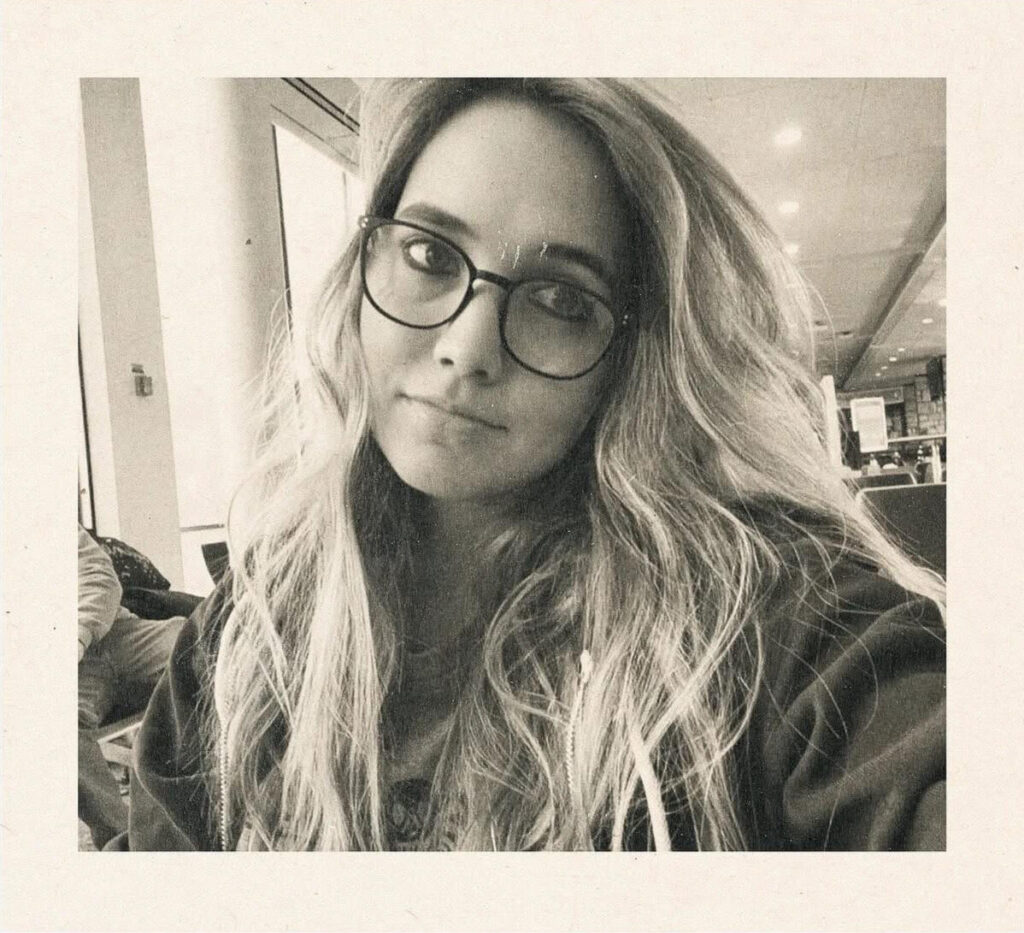
Mallory Smart is an author, editor, publisher, and podcaster. She has had a prolific year with multiple stories published and a chapbook, We All Go A Little Mad Sometimes, from Thirty West Publishing. Her newest horror story collection is Book of David from House of Vlad, out October 7, 2026. An authentic encapsulation of Midwest gothic, Book of David is certainly a haunting collection just in time for Halloween. I sent her a list of questions to learn more about David.
What was the inspiration for the book? Did you set out to write a story collection? How long did it take you to write it?
I wanted to write something that felt like a corrupted Midwestern Bible. There’s obviously the biblical David thing, but also David Koresh. Cults. People becoming mythology. The way some completely normal person can get repeated enough times that suddenly they’re not really a person anymore. And I wanted that person to be Dave. Not some charismatic chosen one. Just Dave. Some miserable guy you worked with or knew in high school or saw at a bar twice. Everyone has a Dave. At the beginning he’s still very human. “In My Friend Dave” he’s basically miserable af, watching Dune: Part Two, getting ignored by his cat and thinking about how bleak everything is. Then you get “Munger Road” and he’s been dead six months and is still texting like that’s apparently fine. Eventually he becomes less Dave and more David. More story than person.
I had written a couple stories before my dad died in May 2025. Then he died and the floodgates just opened. I started writing and publishing short stories constantly and Dave became this figure in my life. At some point I started holding back the stories I thought were strongest because I wanted people to actually have to buy the collection to read them. With “Deadass” I got weird about it and did the opposite. I published the tame version first basically to see if people liked it, then saved the balls-to-the-wall version for the book.
I started sending the manuscript out sometime in October. And by “sending it out” I mean I sent it to one other place besides House of Vlad and mostly prayed to David that Brian would like it.
I know I stopped writing it December 1, 2025 because that’s the day Brian accepted it. He was just like, let’s do it, October 2026. And I was like okay, sick. I stopped fucking with it. Then I got Taco Bell because that’s what you do in the winter in the Midwest suburbs.
Some of the stories have characters with strong familial bonds. How much of this is autobiographical?
The actual events, not necessarily. The emotional geography, def. A lot of it is that weird Midwest family thing where you have siblings and cousins and nieces and nephews who maybe aren’t people you talk to every day, but they still know versions of you nobody else has access to.
“Deadass” is probably the biggest example. It starts with “basement cousins,” which is very much a real category of human being to me. Not really friends. Not exactly close family either. Just people you spent your childhood sitting in basements with while the adults were upstairs being loud. The story literally describes them as shared trauma, seasonal allergies and a group chat nobody knows how to leave. That story is really about people who have drifted apart desperately trying to preserve this bond they once had. Maybe because it was real. Maybe because they need it to have been real. At one point Claire says, “Sometimes I think I remember us wrong. Like I made it up.” That’s the whole thing.
Sometimes you don’t miss a person. You miss who you were around that person. My nieces and nephews and basement cousins are probably the people most hyped about that story. An earlier version ran in Pool Party Magazine, but the book version is basically the feral director’s cut.
What is the sigil seen throughout the book?
It’s partly inspired by the symbol in Twin Peaks, except I turned it upside down. I love Lynch because he can take something completely mundane and make you suddenly realize how surreal it already was. He isn’t inventing some alien universe. He’s like, no, look harder at the diner. Look harder at the suburb. Look harder at the guy smiling at you. WTF is actually happening here?
That’s a lot of what I wanted with Book of David. Gas stations. Strip malls. Dead malls. Highways. Chain restaurants. Suburban houses. Nothing that should be scary, but you pull the curtain back a little and suddenly the whole thing is upside down. And because I wanted the book to have this biblical, culty energy, I knew I wanted recurring symbols too. Stuff that starts to feel like iconography before the reader even necessarily knows what it means.
It’s called Book of David and there is a character called Dave in most of the stories. Are they all supposed to be the same Dave?
They’re all Dave because everyone has a Dave. That’s probably the easiest answer. I think of him as the static running through the book. At first you can still hear the person underneath it. Then the signal starts getting fucked up.
He’s a miserable regular guy. Then he’s dead and texting. Then he’s showing up in other people’s memories. Then people are telling stories about him who may not have even known him. By the end he’s closer to folklore.
There’s a line in “The Joker” that goes, “Everyone has a Dave. Some version of him is trying to lodge himself in your bones as we speak.”
That’s the idea. Person. Memory. Story. Folklore. Mythology.
And weirdly, he becomes more powerful the less defined he gets. By the time he’s fully David, we’ve kind of lost Dave.
There are a lot of tornados mentioned in the book. What is your scariest tornado experience?
When I was six or seven, I got stuck in a tornado with my brother and sister while my mom was out shopping. Cell phones weren’t really a thing yet, at least not in the way they are now, so we couldn’t call her. We didn’t know where she was. And the tornado actually hit. This wasn’t one of those Midwest things where the sirens go off and everyone stands on the porch like idiots and nothing happens.
That experience basically made it into “Friend A”. Kids in the basement with a flashlight, an inhaler and a blanket like any of those things are going to do shit if the roof comes off.
Tornadoes are weird when you grow up in Illinois because they’re terrifying but also mundane af. You hear the siren and know exactly what it means. You know where to go. And then half your neighbors walk outside to look at the sky.
I think that’s why I keep writing about them. The monster isn’t coming from somewhere else. It’s your own sky.
Analog technology, VHS and cassette tapes primarily, are present throughout the book. Do you still use old media formats? What is it about old media formats that makes them so creepy?
I actually consume almost everything digitally, which is maybe the least romantic answer possible. But I collect typewriters, VHS tapes, cassettes, records, old cameras that don’t work. Stuff like that.
And idk if I think old media is inherently creepy. I love it. I think what I’m obsessed with is when it fails. Static. Tracking. A damaged tape. A camera that has something in it but you can’t access it anymore. There’s evidence there. Content. Somebody’s life. But you can’t see it correctly. That’s really interesting to me. There’s content and evidence of what life was like, but it’s distorted. Which is basically memory too.
“Handbook for the Recently Deceased” and “Thank You for Holding” are two stories that are unconventional story formats. What was the inspiration for those two stories?
“Handbook for the Recently Deceased” has a really sweet origin because my brother introduced me to Tim Burton and Beetlejuice when I was a kid. It’s weird how your sibling showing you one movie can basically infect your imagination forever. Then I started thinking about what an actual handbook for being dead would look like. And obviously humanity would manage to make dying bureaucratic. Forms. Departments. Rules nobody explains. Some poor ghost stuck dealing with paperwork.
“Thank You for Holding” was different because I actually resisted that title for a while. I thought it sounded too obvious. Too easy. But every time I heard the story in my head, that phrase kept coming back. Thank you for holding. That specific hell of getting transferred over and over and nobody actually answering your question. Then I got curious about dying and not knowing you died. No handbook. No angel. No giant revelation. You just somehow have access to a helpline and have to call and ask wtf happened.
The story is literally framed as a recovered transcript from an Afterlife Help Line. And there’s something so funny and horrible about somebody having to confirm, yes, you are dead, and btw here is the incredibly mundane thing you were doing when it happened. In hindsight, I think some of it came from a conversation I had with Krystle Ratticus on Textual Healing, which, let’s face it, is where some of my favorite conversations happen. I asked what her embarrassing red-light song would be. Like the song you turn down when another car pulls up because you don’t want them knowing what you’re listening to. She turned it into: what would be the most embarrassing song to be listening to when you die?
And that stayed in my brain.
I think we landed on an ’80s power ballad. Which I’d be embarrassed by but also, honestly, very fitting. So cinematic.
“Handbook for the Recently Deceased” reads like a handbook for millennials dealing with aging. Nobody is focused on millennials now, the spotlight is all on Gen Z. What do you think happens after we die?
I love that this goes directly from nobody cares about millennials anymore to what happens after we die. I have absolutely no idea. I’m not even sure there is anything after death. But if there is, I assume it’s Kafkaesque af. You get there and realize you’ve been in the wrong line for three hours. There was a form you were supposed to bring. Nobody told you about the form. The office that handles the form closed in 1847.
So basically “Handbook for the Recently Deceased”. We’re probably on hold.
If you could have one story from this collection turned into a movie, who would you cast in it or direct it?
I’ve thought about this way too much. “Deadass” is probably the clearest movie. It’s self-deprecating. It’s marketable. It has this big group dynamic. Then the ending is gutting in the best way. I’d want Matt Bettinelli-Olpin and Tyler Gillett because it has a little Ready or Not energy. Cast-wise, people like Jenna Ortega, Freddie Highmore, Kristen Stewart, Kathryn Newton. That kind of group would be lit.
But honestly, the story I would be most interested in actually watching is “Munger Road”. Which is funny because somebody already made a really bad movie about the Munger Road legend in St. Charles years ago and it sucked. The only notable thing I remember about it is that it had the guy who played the senator in the first X-Men movie.
So I’d like another shot. Ari Aster directing. Evan Peters as Dave. Evan Peters is probably my favorite Dave because he can blend into so many different kinds of people and then descend into something totally different. Sometimes he does that shit within one episode of American Horror Story.
Imagine him as Dave.
Freddie Highmore is my other major Dave candidate. But Evan Peters is the one.
What are your top five horror writers or novels?
Stephen King. David Lynch. Jane Schoenbrun. Grady Hendrix. William Peter Blatty. And yes, Lynch and Schoenbrun count as horror writers. They write horror. I’m not disqualifying somebody because the words happen to end up on a screen instead of between two covers. That’s bullshit.
King is probably the most obvious answer in the world, but he gets that you need to care about the people and the town before you fuck everything up.
Lynch is massive for me because of that surreal-behind-the-mundane thing. He understands that normal American life is already weird as hell. You barely have to push it.
Jane Schoenbrun’s I Saw the TV Glow directly influenced one of the stories in this collection. That movie wrecked me. The way nostalgia, media and identity all start blurring together. Something you watched becomes evidence of another version of your life.
Grady Hendrix understands that horror can be funny af and still actually hurt.
And Blatty because The Exorcist is basically perfect at treating faith, doubt and evil like real questions instead of giving you some clean little answer.
Ask me tomorrow and I’ll probably have a different five. Top-five questions are evil.
How was it like working with House of Vlad? How did they help shape the book?
Brian was insanely supportive. I sent him the manuscript and instead of nitpicking the shit out of it or spending six months mulling over details, he basically said, let’s do it. October 2026.
And then we went from there. It was very casual. A lot of trust. Idk if working with me is different than working with other writers because I’m also a publisher. I tend to finesse things pretty hard before I send them anywhere because I know what it’s like to get a manuscript where the author is still expecting you to figure out what the book is. I try not to do that. So I knew what I wanted.
And Brian never questioned the weird visual shit. When I said I wanted the cover to feel like some decaying Bible you found in an abandoned suburban church basement, he wasn’t like, can we make that more commercial? He loved it. He got the lore immediately.
That mattered a lot because the book itself opens like corrupted scripture. David’s words are getting written down on greasy napkins, dead receipts, old tape sleeves, all this trash basically becoming sacred objects.
I did not want someone asking me to explain Dave to death. Brian trusted me not to.
And honestly, the way he accepted it made me trust the book more too. December 1 was the day I basically stopped touching it. Sometimes someone says yes that confidently and you should probably stop fucking with the thing.
This book is different from your previous books. Those were more prose driven. Is there anything that caused the change in your writing style?
Yeah. I think you’re picking up on something real. When my dad died in May 2025, I had only written two of the stories that ended up in Book of David. Then everything came pouring out. I’ve read about this thing where sometimes a creative person loses a parent and suddenly they lose one of their earliest internal critics too. And that hit me hard because I think that happened to me.
Not like my dad was sitting there critiquing my fucking sentences. It was way more subconscious than that. I just felt less observed. Less guarded. I wasn’t holding back the same way.
And I think I finally let myself sound more like me. I’ve always had this choppier, more abrupt side to my writing, but before I think I was trying to smooth it out. Make it prettier. Make it sound more “literary.” Whatever tf that means.
After he died I stopped caring as much. I became more direct. Less delicate, especially about family. More willing to let something be ugly or funny or blunt and not explain it afterward. Part of that was grief. Part of it was probably just getting older and having more confidence. Knowing what I wanted to say. Not needing to prove I could write a pretty sentence every five seconds. “Coming Up on 33 Below” is probably the clearest example. After my dad died, my siblings and I went through his things trying to figure out who this person actually was. I don’t think I had a real conversation with him my entire life.
So I became weirdly obsessed with the idea that we were going to find something. Some huge bombshell. Something completely insane that suddenly explained this human being I barely knew. Like, okay, surely there’s a drawer somewhere that contains the answer. Sadly there was no bombshell. Which was almost more interesting. You’re left with somebody’s shit. Other people’s memories of them. Your memory. Objects. Stories. Weird little scraps. And you’re trying to assemble a human being out of all of it. That process is all over “Coming Up on 33 Below”. It literally opens with the siblings entering this decaying place their dad left behind, with one brother already wearing Dad’s Sox hat and physically resembling him.
So no, I don’t think I randomly changed styles. I think I lost my critic. I became less guarded.
And I finally stopped policing the choppier part of myself. It felt like I was finally able to just be me on the page.
Are you working on any other writing projects?
Always. Unfortunately. I’m playing with another horror novel, but I’m being vague on purpose because I don’t want to give it away while it’s still mine. I’m also becoming very interested in Balkan folklore and what I can do with that. Different mythology. Different landscapes. Different kinds of stories people tell because everybody knows them but nobody actually knows where the hell they came from.
So yeah, more horror.
My brain has apparently decided that every place I go needs to become threatening eventually.
Mallory Smart is Editor-in-Chief of Maudlin House and host of the Textual Healing podcast, and her books include We All Go a Little Mad Sometime (Thirty West Publishing, 2026), I Keep My Visions to Myself (WithanX Press, 2023), and The Only Living Girl in Chicago (Trident Press, 2021).
Benjamin Scott runs the indiebookblog.com and lives in the Midwest.