
Ever since I first sat down with Nathan Ballingrud’s collection North American Lake Monsters, I’ve been enthusiastic about his work. The stories in that collection and its followup, Wounds, abounded with moments of dread both primal and existential. Film and television adaptations followed; then Ballingrud zigged when I expected him to zag, via the novel The Strange, set in an alternate past where other planets in the solar system can sustain human life without any sort of terraforming.
From there, he’s shifted gears again with the Lunar Gothic trilogy, of which the magnificently-titled Crypt of the Moon Spider was the first volume. As one might gather, that one was set largely on the Moon in an alternate 1920s, one where the legacy of giant intelligent spiders is still perceptible and where their webs hold the key to enhancing humans in often-bizarre ways.
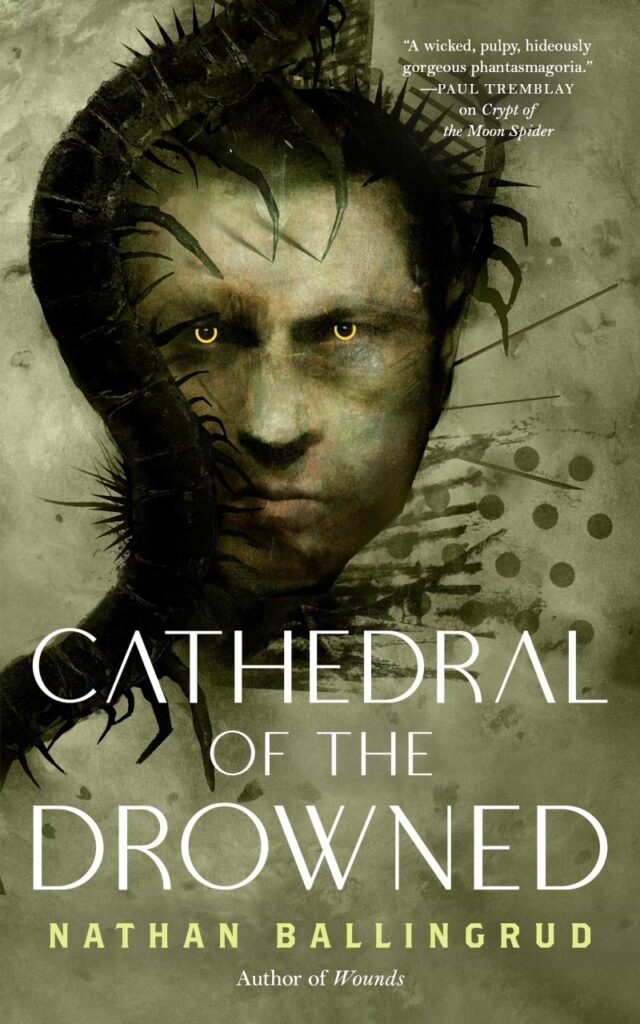
Cathedral of the Drowned is the second volume in the trilogy, and in some ways it’s a classic middle volume. Characters who were in the background of its predecessor — specifically, the Red Hook-based crime boss Goodnight Maggie — take center stage here, but there’s also a larger conflict playing out. While the Moon is still a presence (and a location) here, much of the action takes place on Earth and on the Jovian moon of Io. And if you thought spiders on the Moon were weird, well, get ready for the superintelligent centipede that calls Io home.
Maggie is a memorable antihero, capable of being utterly ruthless at moments and deeply tender at others. At the center of that tenderness is Charlie Duchamp, who she’d previously sent Moonward and who was the subject of experiments by Dr. Barrington Cull. Specifically, Charlie has had his brain halved and blended with spiders’ silk. The result? Two Charlies: one, disembodied, installed in a satellite and sent to Io; the other rendered emotionless and violent, and preferring to use the name Grub.
Certain aspects of Cathedral of the Drowned are, for all intents and purposes, crime fiction. Maggie takes in Dr. Cull after the events of Crypt of the Moon Spider, and it’s clear from the outset that whatever fragile alliance the two have is unlikely to hold. Maggie is also working against a rival crime family, and those machinations drive part of the plot — even as things are getting stranger and stranger in the margins.
Part of that relates to what Charlie finds on Io, which includes the remains of a religious expedition sent there and the massive, hungry, sentient centipede that rules over that moon. There’s room for big ideas here: if you’ve ever wondered about the identity of two different people each containing half of a previously-intact brain, this novella will leave you with plenty to think about.
Aspects of this alternate history echo elements of our own. The trade in spiderwebs, and the way that it can turn violent, echoes Prohibition, and Dr. Cull’s authoritarian experiments also correspond to some very real parts of early-20th century medical history. That Dr. Cull — easily the most ruthless and unsympathetic character here — displays an aptitude for survival seems highly intentional with respect to the power dynamics of this world.
In thinking about this trilogy thus far, it seems to me that Ballingrud has staked out a position somewhere between the disquieting horror of his short fiction and the pulpier aspects brought to the forefront in The Strange. But that’s not entirely accurate; there’s also a phantasmagorical quality to the way that the lunar spiderwebs allow a surreal form of, effectively, teleportation.
Throw psychic connections into the mix and you have a work that isn’t just set in the early 20th century — it also evokes some of the same fiction of the period, or what Joshua Glenn has dubbed the “Radium Age.” In its sense of dread, its flawed characters, and its bizarre imagery, Cathedral of the Drowned echoes much of Ballingrud’s previous work — but it also has plenty in common with the works of, say, William Hope Hodgson. As befits its more delirious qualities, this latest entry in the Lunar Gothic trilogy feels like an object born from some mysterious time, broadcasting an unsettling message.
***
Cathedral of the Drowned
By Nathan Ballingrud
Tor Nightfire; 136 p.