
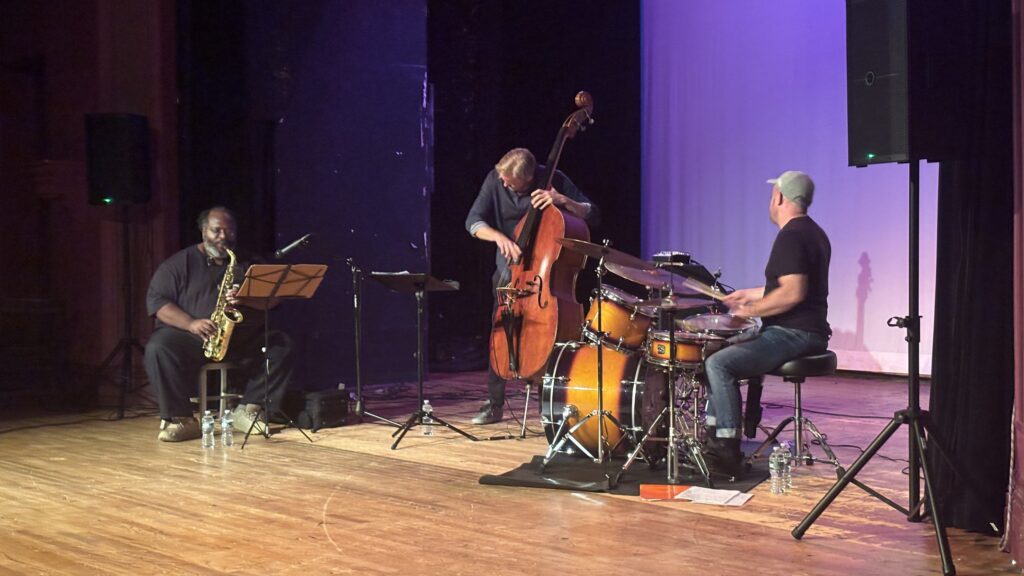
Darius Jones sits alone on stage minutes before tonight’s show at the Cunneen-Hackett Arts Center in Poughkeepsie, calmly detonating blasts from his alto saxophone, two-to-three second streaks booming across the theater and fading to a moment’s silence just in time for the next one. They’re foghorn loud, piercing, but they seem like more than mere warm up exercises. Perhaps he’s testing the structural integrity of the joint and/or mapping the room’s acoustics—gauging the capabilities of tonight’s worksite and the best ways to utilize them.
***
I first encountered the music of Darius Jones over a decade ago at a show at Shapeshifter Lab in Brooklyn. I went to see another group but it was Jones and his band I thought about on the way home. I bought a copy of Jones’s debut album CD, though it didn’t strike me the way the show did. I didn’t yet have the ears. Still, I thought I might catch up one day, so the album survived a decade’s worth of CD purges. Fast forward to Jones’s latest album, Legend of e’Boi (The Hypervigilant Eye) and a check in long overdue. It’s all there from the top of the first tune—his beautiful tone, his compositions, the ways he crosscuts against the propulsive rhythm section of drummer Gerald Cleaver and bassist Chris Lightcap. I don’t know what I was missing before, but Legend of e’Boi has been in regular rotation for months. I couldn’t believe my good fortune when my friend James shared that Jones and his trio would be playing in Poughkeepsie, as part of the Elysium Furnace Works series, in a few weeks.
***
In her latest book, Keep an Eye on the Figs! An Ode to Pittsburgh’s International Grocers, Karen Lillis collects photographs of the city’s grocery stores. The book is as wonderfully specific as the subtitle suggests and equally mind (and heart) opening. People and foods from across Africa, the Americas, Asia, and Europe are represented in images of bilingual signs and handwritten price lists, racks of brightly colored drinks and boxes of fruit stacked on tile floors, along with wall murals, mosaic entry ways, and myriad other visuals related to Steeltown grocers.
***
Legend of e’Boi jolts from the jump. On the lead track, “Affirmation Needed,” Jones snags a riff and plies variations fueled by the rhythm section’s injections of groove and thump, which spur Jones’s increasingly vivid explorations. The song’s arrangement is stripped down—unfiltered and uncluttered—emphazing each player’s performance and maximizing the power trio dynamic (which, in turn, reminds me of Jimi Hendrix circa the Band of Gypsies). Cleaver breaks away and then returns playing the snare on each beat. It feels like he’s pushed the song into double time even though the tempo holds steady, heightening the tension. From there Jones springboards to the highest reaches of his remarkable range. Between spins I wonder about the song title. Is it external and/or internal affirmation Jones seeks? To what extent are his sojourns, solo and with his bandmates, inward or outward looking? The title suggests vulnerability and curiosity, the thoughts of a seeker, while the music conveys a burning immediacy. It’s a fascinating yin and yang.
***
The photos in Keep an Eye on the Figs! center on physical spaces, but Lillis’s bountiful portraiture celebrates the people behind the scenes, which she makes clear in her afterward:
“…Walk into a Pittsburgh grocery and you walk into the history of cities themselves. The why and the how people cross borders, cross oceans, seek new places. The why and the how they seek each other. Keep shopping long enough and you’ll learn that your grocer came here to escape war, to escape a draft, to escape minority persecution, to go to school, to find better opportunities, to renew hope. To feed his family by feeding yours.”
***
When introducing Darius Jones at tonight’s show, James shared an anecdote from a few years prior. He and Jones were out to dinner. The waiter, learning that Jones is a musician, asked what kind of music he played, to which Jones responded, “soul music.”
***
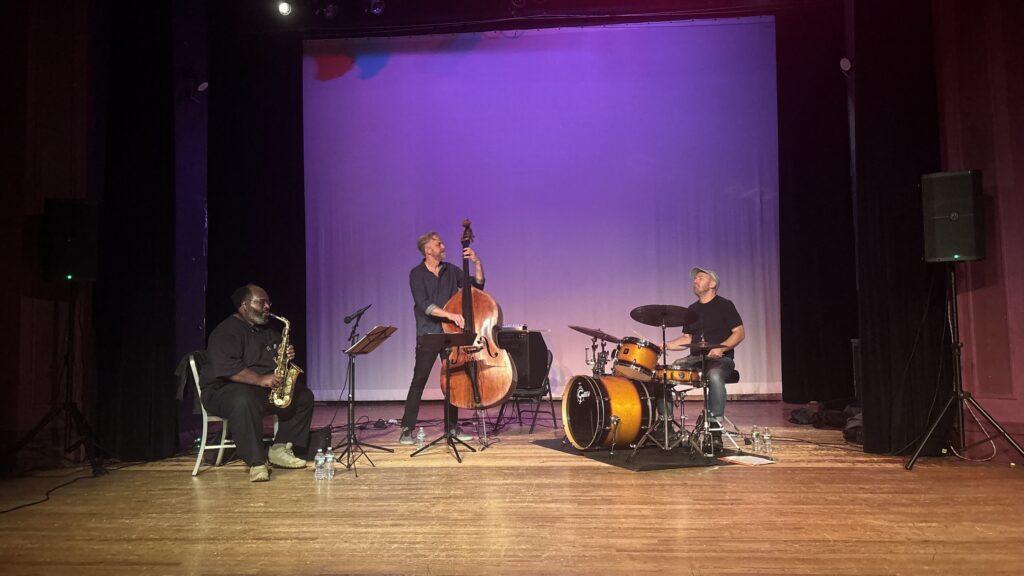
Jones explores and nurtures his soul in ways that will feed yours. Further proof lies in “Another Kind of Forever,” which opens with a call and response volley between Jones and Cleaver. Then Cleaver taps quarter notes in 6/8 time (or is it 3/4? I tangle the two) while Lightcap locks into a melodic, driving loop. Jones blazes in sweet and smooth, then jarring and serrated and countless places in between and beyond. Like a great novelist, he can take us in unexpected directions because he is constantly grounded in the song’s internal logic. And we are, too, though sometimes I find myself so magnetized by a particular thread that I momentarily lose track of others. I dust myself off and consider the best way to reconnect. Can I jump back into the song in the moment or is it best to wait for the initial phrase to come back around? The merry go round spins on and even after listening to the album dozens of times, I wonder what lies ahead.
Jones keeps the burners on high coming down the home stretch. He repeats the main theme a dozen times, takes a momentary break, and repeats it 21 times, each building on the last. Or maybe it’s 13 and 22. I kept getting different counts and then stopped keeping track because scratching tally marks on a note pad is a misguided pursuit with music this good.
Legend of e’Boi (The Hypervigilant Eye) has no guest musicians, no overdubs, nor any electronics. The word “raw” comes to mind, but that implies uncooked, a slab of something unfinished sitting on the counter requiring additional preparation prior to ingestion. These tracks are fully realized, each song imbued with a distinct sense of exploration and declaration. Even the parenthetical portion of the album title is provocative. How does the Hypervigilant Eye factor into the equation? Does the eye seek and/or offer affirmation? I also wonder about Jones’s use of “hyper,” what has elevated vigilance to hypervigilance? Legend of e’Boi resonates during and between listens like few albums.
***
Henry Jimpson Wallace recorded only two songs in his lifetime, but those tracks—cut with Alan Lomax in 1947—have been re-released numerous times in the nearly 80 years since. Learning more about Wallace is challenging, though—systemic racism in full force. Across the many compilation albums on which his songs—“No More My Lord” and “Murder’s Home”—have appeared, Wallace is often minimized if not scrubbed from the record. On several releases he is listed only by his last name. The credits on the Gangs of New York soundtrack state only, “Jimpson and Group.” On at least one record, Wallace is not named at all.
***
Clint Smith is a remarkable portrait artist across his poems and essays, especially in his second book, How the Word Is Passed: A Reckoning with the History of Slavery Across America. Smith visits seven sites associated with the history of slavery—plantations, prisons, cemeteries—and peels back the layers. Yet no matter what manner of past-to-present connection he’s about to unveil, he lingers long enough to sculpt vivid depictions of the people he encounters. The director of operations at the Whitney Plantation in Louisiana, tour guides at the Blandford Cemetery in Virginia and the National Museum of the American Indian in New York City—allies and apologists alike are humanized, placed on equal footing, as they look Smith—and by extension, us—right in the eye, whether they’re speaking truth to power or contorting themselves to rationalize distorted notions of the Confederacy’s treachery.
***
Darius Jones is a portrait artist in his own right. The last song on Legend of e’Boi is his interpretation of Wallace’s “No More My Lord,” which also closes the concert. Jones introduces the song by saying, “Henry Jimpson Wallace was ‘captured’ by Alan Lomax. It’s important to acknowledge a human life. He was not famous, but he created something beautiful. Tonight I’m going to shine a little light on him, and I hope his refrain helps us all.”
Chris Lightcap illuminates from the deep recesses of his bass, sawing back and forth, trance-inducing and foreboding. The drumming, courtesy of Jason Nazary, playing in place of Gerald Cleaver, seems circular; Nazary creates upward thrust orbiting beats rather than landing on them. Meanwhile, Jones plays like he’s pacing, building to distress level shouts amidst the droning bass and maelstrom of drums, echoes of what he played before the show. The combination is combustible, ecstatic, pushing the piece into a parallel world, reminiscent of the studio version, but lifting us to a different realm, exhilarating discoveries within familiar frameworks. This is deep playing, to paraphrase Pauline Oliveros, whole body and soul playing, Jones pushing himself to and past the brink, coating the theater walls, before gracefully coming to rest as Lightcap and Nazary play on.
Jones closes his eyes and listens, taps his foot, and turns his head side to side. The night’s work is nearly done and he steps back from the canvas, a moment for all of us to squint, hold out a thumb, and consider all that’s gone down before the final brush strokes are applied. Jones and his trio have created a generous and beautiful refrain, a disruption, welcome and uplifting.
Photos: James Keepnews